

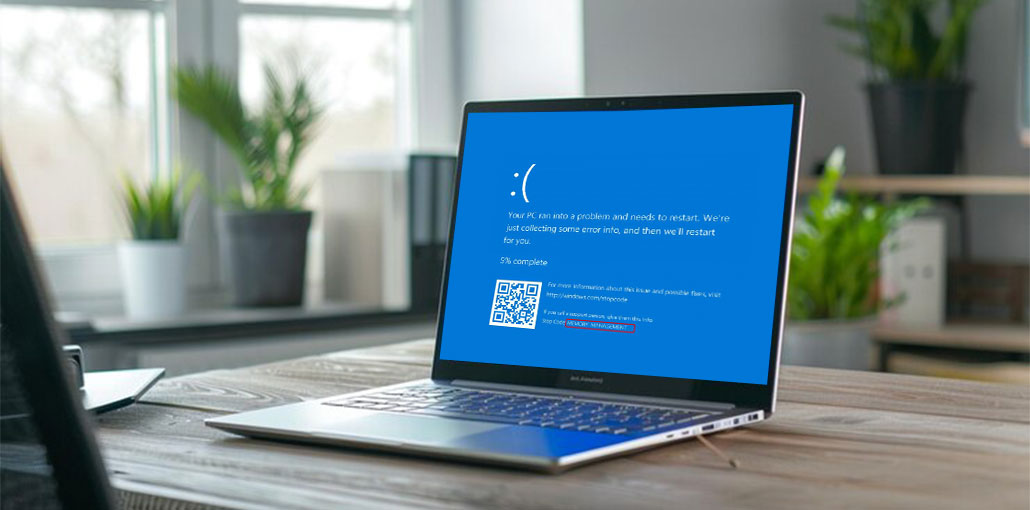
Windows will display a sequence of errors and stop code memory management on the PC (mainly the drive) fails to function properly. Memory management errors are one of many errors that are often displayed on the blue screen. If you are confronted with this error, you will find Memory Management blue screen solutions in this article.
Memory Management Error Windows 10/11
Computer memory refers to all physical devices that are used to store information using integrated circuits. Information can be stored in a temporary manner, such as RAM (random access memory), or for a long time, as with ROM (read-only memory).
What Is Memory Management in An Operating System?
As its name implies, memory management is a function that manages the memory of the computer within an operating system. The principal purposes for Windows memory management include:
- Keep control of every storage place (both allotted and unlocked).
- Determine how to allocate memory in the competition process.
- Choose which memory to receive the memory for, when to receive it, and the amount it will cost.
- Give a memory location once the allocation process for memory is complete.
What Is Memory Management Error
Memory management error refers to an issue that affects a computer’s memory. It could be due to an actual issue with memory or a malfunctioning memory. One of the main reasons to cause the error in memory management that appears on Windows 10 (MEMORY_MANAGEMENT BSOD error Windows 10) is an outdated or damaged graphics card driver (especially in the case where the graphics card includes memory).
Memory Management Blue Screen Error
If you see a BSOD MEMORY_MANAGEMENT Windows 10, it means that your system has detected a serious problem with memory management. Memory Management blue screen error is displayed on your computer screen, in conjunction with (or without) the stop code like 0x0000001A. When there’s a major issue identified, a MEMORY_MANAGEMENT error may show up on your computer screen, leading to an unreadable blue screen.
Also read: 8 Ways to Fix Video Scheduler Internal Error on Windows PC
What Causes Memory Management Blue Screen
There are numerous possible reasons for the Windows 10 blue screen memory management issues: disk errors and damaged or outdated drivers, bad memory/RAM, and so on.
9 major causes of Memory Management blue screen of death in Windows 10:
- Windows Update: If you update to Windows from an earlier version, this issue might be displayed.
- Disk errors: Errors were discovered on the disk that is mounted to this computer.
- Graphics driver problem. The drivers of devices aren’t working or are outdated, damaged, or corrupted.
- Virus infection: A computer virus infects your system and damages it.
- Memory error: The memory is incorrect.
- A faulty RAM: This is because the RAM (Random-access memory) fails.
- Hardware issues: Hardware problems were discovered in one or more devices (such as graphics cards).
- Software issue: The problem is in one or more areas of the programs ( corrupt files and the operating system is not working are also included).
- Hardware or software conflict: Software/hardware conflict with other hardware/software.
How to Fix Memory Management Error in Windows
1. Restart Your Computer
If you are confronted with the MEMORY_MANAGEMENT error that you encounter on your PC, go for the most basic and most commonly used method – restarting your computer. Some users have reported that the error in memory management won’t occur after the restart, but others are still troubled by the issue.
If the error message MEMORY_MANAGEMENT is still visible when you’re operating your computer, you should try the troubleshooting techniques for advanced users below.
2. Run the SFC Scanner
Systems File Checker (SFC) is a Windows built-in program that can handle problems with the system. The SFC /scannow operation is by far the most frequently used option to test the integrity of the system files. It will reveal the corrupted or missing documents and substitute them with the right ones.
- Press Win + X and select Windows Terminal (Admin) or Command Prompt (Admin).
- Type the following command and press Enter: sfc /scannow
- Wait for the scan to complete.
3. Perform CHKDSK
CheckDisk, which is abbreviated by the abbreviation CHKDSK It is a free software to check the file system. Contrary to SFC, CHKDSK scans the entire drive for any errors. The CHKDSK tool on all Windows operating systems and can run it through the Command Prompt.
- Open Command Prompt (Admin).
- Type the command: chkdsk /f /r
- Press Enter and follow prompts.
4. Use the Windows Memory Diagnostic Tool
A damaged or corrupted RAM can be the most common reason for the memory management error on your PC. It is possible to swap it out with a brand new driver to fix the issue effortlessly. However, before doing that, you must use an initial scan using the Windows Memory Diagnostic Tool to be sure that it’s not broken.
If the Windows Memory Diagnostic Tool is running, Windows will start to look for memory issues. You must be patient until it is finished.
If there is no issue, your memory on the PC may be in good condition. Therefore, you may want to explore other ways to resolve the blue screen of death memory management issue.
Also read: How to Fix Windows Update Errors in Windows 10
5. Run a Full System Scan
A virus or malicious software can cause a variety of issues on your computer, for example, BSOD issues. It is possible to run a complete scan to see if malware is on your system. The Windows system comes with its own antivirus software.
6. Update Drivers
A broken or outdated driver for the graphics card could result in a memory management error that occurs in Windows. Furthermore, the drivers included with the latest hardware might be causing problems. Thus, updating drivers can be a quick and simple solution.
7. Clear Temporary Files and Folders
If there are a lot of temporary folders and files, this could cause applications to slow down, affect the speed of processing, and cause errors. It is possible to use Disk Cleanup to delete all the unnecessary files. It is a Windows snap-in utility that will clean up and delete undesirable files.
- Press Win + R → type cleanmgr → Enter.
- Select your system drive (usually C:).
- Check all boxes for temporary files → click OK to delete
Other Fixes for Memory Management Blue Screen Error Windows 10/11
If you are still unable to fix your issue with the Windows Stop code MEMORY_MANAGEMENT (blue screen MEMORY_MANAGEMENT) in Windows 10/11, you might also try these options.
- Take out the recently installed software and equipment.
- Enlarge the Virtual Memory.
- Find out about software issues such as software corruption and conflicts.
- Upgrade Windows 10 to the latest version.
- Change the settings of your PC to the default settings if you’ve altered the clock speed of your computer.
- Utilize your System Restore feature.
- Reset or reinstall Windows 10 (it’s the final one to be reset).
Ending Notes
Memory management BSODs appear to be difficult to deal with, particularly for new computer users. The memory management issue could arise due to a variety of causes in various situations. However, you can fix the Memory Management blue screen issue using the techniques that were previously discussed.
FAQs: Memory Management Blue Screen
What is stop code 'Memory Management' in Windows 10/11?
The 'MEMORY_MANAGEMENT' stop code is a blue screen (BSOD) that means Windows detected a serious problem in how system memory (RAM + paging file + system files) is being managed. It usually points to issues with RAM, drivers, disk, or critical system files rather than a simple app crash.
Can RAM cause a Memory Management blue screen?
Yes, bad or incompatible RAM is one of the most common causes of the MEMORY_MANAGEMENT BSOD. Defective modules, mixing mismatched sticks, or unstable overclocked RAM can corrupt data in memory and immediately trigger this stop code.
Best settings to prevent Memory Management blue screen
Keep RAM and CPU at stable (non-extreme) clocks, enable XMP only if the system is stable, and avoid mixing different RAM kits or speeds. Also keep Windows and all drivers updated, run occasional disk and system-file checks (DISM, SFC, CHKDSK), and ensure good cooling to prevent overheating-related memory errors.
How do I check if my RAM is bad for this error?
First, run Windows Memory Diagnostic (press Windows + R → type mdsched.exe → restart and check for problems) to scan for memory errors. For deeper testing, use tools like MemTest86 or test sticks one by one in different slots to see if specific modules cause the BSOD.





Leave a comment