


Blog 5 — Toward Trustworthy Cybersecurity AI
Artificial intelligence is rapidly becoming an operational decision-making component rather than merely an analytical tool. Modern cybersecurity systems increasingly rely on AI to prioritize alerts, classify threats, recommend mitigation strategies, and even execute defensive actions autonomously. As these responsibilities expand, a fundamental question emerges: Can an AI system be trusted to make security-critical decisions?
For years, the cybersecurity community has evaluated AI primarily through predictive performance. Higher accuracy, stronger F1-scores, and lower false-positive rates have been viewed as evidence of better intelligence. However, operational cybersecurity is fundamentally different from benchmark evaluation. Security environments are dynamic, adversarial, uncertain, and continuously evolving. A model that performs exceptionally well during evaluation may become unreliable when exposed to unseen attacks, changing infrastructures, or deliberate adversarial manipulation.
This distinction reveals one of the most important misconceptions in modern AI: high predictive performance does not necessarily imply trustworthiness. Trustworthy cybersecurity AI is not defined by how accurately it predicts under ideal conditions, but by how responsibly, transparently, and reliably it behaves when conditions become uncertain, unexpected, or intentionally hostile. Trustworthy cybersecurity AI is the ability of an intelligent system to make reliable, transparent, accountable, and governable decisions under uncertainty, failure, and adversarial conditions throughout its operational lifecycle.
Rather than representing another AI capability, trustworthiness should be viewed as an architectural property emerging from the integration of multiple complementary capabilities, including uncertainty awareness, failure awareness, explainability, governance, operational monitoring, and meaningful human oversight. Only through the coordinated integration of these components can AI become a dependable cybersecurity partner for cybersecurity operations.
Trust Is Not a Confidence Score
A persistent misconception in artificial intelligence is that model confidence can be treated as evidence of trustworthiness. Modern machine learning systems commonly attach confidence scores to their predictions, encouraging users to interpret a higher score as a stronger indication that the decision is correct. In practice, however, confidence reflects only the model’s internal assessment of a prediction and may remain high even when the prediction is wrong.
Confidence, reliability, and trust represent distinct concepts. Confidence is a numerical output associated with a specific prediction. Reliability reflects the extent to which a model behaves consistently across changing data distributions, operational contexts, and threat conditions. Trust is broader still. It concerns whether human operators can depend on the entire decision-making process, including the system’s ability to identify uncertainty, recognize its limitations, explain its reasoning, withstand manipulation, and operate within established organizational and governance boundaries.
This distinction is especially important in cybersecurity. A model may assign very high confidence to an incorrect decision when exposed to previously unseen attacks, distribution shifts, poisoned data, or carefully crafted adversarial inputs. By contrast, a trustworthy system may reduce its confidence, abstain from making a decision, request additional evidence, or escalate the case to a human analyst when the available information is insufficient. Such cautious behaviour should not be interpreted as a weakness; in high-risk environments, it is often a sign of operational intelligence.
Trust, therefore, cannot be derived from a confidence score alone. It must be established through consistently reliable, transparent, robust, and accountable behaviour across the full AI lifecycle of the AI system.
Also read: Frontier AI Security: From Prediction to Trustworthy Intelligence | Act I — The Reality Check
Trustworthy AI as an Architectural Property
Trustworthy AI is not achieved by adding individual mechanisms to an already deployed model. In many existing systems, capabilities such as explainability, monitoring dashboards, governance frameworks, or human review are introduced only after the model has been developed, with the expectation that they will compensate for underlying weaknesses. While these components undoubtedly improve operational visibility and oversight, they cannot fundamentally transform an unreliable AI system into a trustworthy one.
Trustworthiness must instead be designed as a foundational architectural property. It should be embedded throughout the entire AI lifecycle from data acquisition and model development to deployment, continuous monitoring, adaptation, and eventual retirement. Every stage contributes to the system’s ability to make reliable decisions, recognize its own limitations, communicate uncertainty, and operate responsibly under changing and adversarial conditions.
From this perspective, trustworthiness emerges from the integration of multiple complementary capabilities rather than any single technique. A trustworthy cybersecurity AI continuously estimates the reliability of its predictions, recognizes when it is uncertain or likely to fail, explains the reasoning behind its decisions, withstands adversarial manipulation, monitors its behavior during operation, complies with organizational and regulatory requirements, and enables meaningful human oversight whenever autonomous decisions require verification or intervention.
Consequently, trust should not be viewed as an additional module that can be attached to an existing AI system. Instead, it is an emergent architectural property that arises from the coordinated interaction of reliability, self-awareness, transparency, robustness, governance, and human collaboration. Only when these capabilities are designed to function together can AI become a dependable and operationally trustworthy partner for cybersecurity.
The Pillars of Trustworthy Cybersecurity AI
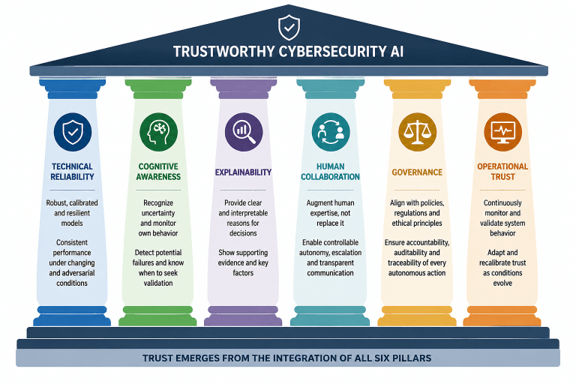
Trustworthy cybersecurity AI cannot be achieved through a single algorithm, model, or security mechanism. Instead, it emerges from the integration of multiple complementary capabilities that collectively enable AI systems to operate reliably, transparently, and responsibly in complex and adversarial environments. These capabilities can be organized into six foundational pillars that together define a comprehensive architecture for trustworthy cybersecurity intelligence.
The first pillar, Technical Reliability, establishes the foundation for dependable decision-making. It focuses on developing models that are robust, well-calibrated, resilient to distribution shifts, and capable of maintaining consistent performance even under evolving operational and adversarial conditions.
Building upon this foundation, Cognitive Awareness enables AI systems to reason about the quality of their own decisions. By estimating uncertainty, monitoring internal behavior, recognizing potential failures, and identifying situations that require additional validation, the system develops a level of self-awareness that is essential for safe autonomous operation.
The third pillar, Explainability, ensures that AI decisions are transparent and interpretable. Rather than producing opaque predictions, trustworthy AI should communicate the rationale behind its decisions, identify the evidence supporting its conclusions, and provide sufficient context for analysts to understand and verify its recommendations.
Since cybersecurity remains fundamentally a human-centered discipline, the fourth pillar, Human Collaboration, emphasizes meaningful interaction between analysts and intelligent systems. Trustworthy AI should augment—not replace—human expertise by supporting controllable autonomy, enabling appropriate escalation, communicating uncertainty effectively, and allowing human operators to verify or override critical decisions whenever necessary.
The fifth pillar, Governance, extends trust beyond technical performance by ensuring that AI operates within organizational policies, regulatory requirements, ethical principles, and established accountability frameworks. Every autonomous decision should remain transparent, auditable, reproducible, and aligned with the objectives and responsibilities of the organization.
Finally, Operational Trust recognizes that trust must be maintained continuously after deployment rather than assumed at deployment time. Through runtime monitoring, adaptive trust calibration, performance validation, and continuous assessment of system behavior, AI can preserve its reliability as operational environments, threat landscapes, and mission objectives evolve.
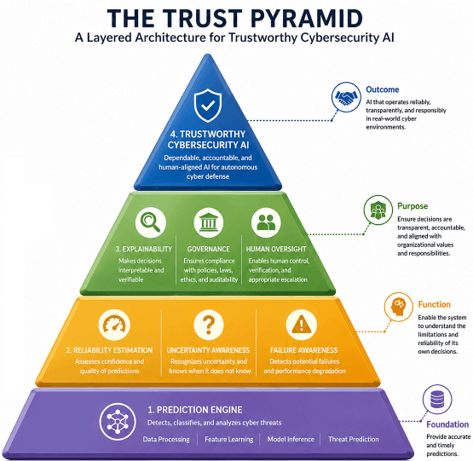
Together, these six pillars (Figure below) form an integrated framework in which trustworthiness is not treated as an isolated capability, but as an emergent property arising from the interaction of reliable learning, self-awareness, transparency, human collaboration, governance, and continuous operational assurance. The pyramid illustrates that trust is accumulated rather than added. Each higher layer depends on the integrity of the layers beneath it, making trustworthiness the emergent outcome of progressively richer cognitive and operational capabilities.
The Trust Pyramid
The evolution toward trustworthy cybersecurity AI can be represented as a layered architecture (figure below) in which each level builds upon the capabilities established below it. Trust does not emerge from a single model or mechanism; it is progressively developed through increasingly sophisticated levels of intelligence and operational responsibility.
At the foundation of the pyramid is the Prediction Engine, responsible for detecting, classifying, and analyzing cyber threats. Built upon this foundation are Reliability Estimation, Uncertainty Awareness, and Failure Awareness, which enable AI to assess the quality of its own predictions, recognize its limitations, and identify situations where autonomous decisions may no longer be reliable. The next layer incorporates Explainability, Governance, and Human Oversight, ensuring that AI decisions remain transparent, accountable, auditable, and aligned with organizational objectives. At the apex of the pyramid lies Trustworthy Cybersecurity AI, representing the seamless integration of these capabilities into an intelligent system that can operate reliably, responsibly, and collaboratively in complex cyber environments.
Each layer strengthens and depends upon the layers beneath it. Accurate prediction provides the foundation for self-awareness, self-awareness enables transparency and accountability, and together they establish the conditions necessary for trust. In this sense, trust is not an isolated capability but the culmination of a progressively integrated cybersecurity AI architecture.
Explainability Is Necessary, But Not Sufficient
Explainability has become one of the most widely adopted approaches for increasing transparency in artificial intelligence. Techniques such as feature attribution, saliency maps, surrogate models, attention visualization, and rule extraction help reveal how AI systems arrive at their predictions, enabling analysts to better understand the reasoning behind individual decisions.
While this transparency is valuable, explainability alone does not make an AI system trustworthy. Understanding why a model reached a particular conclusion is fundamentally different from knowing whether that conclusion is reliable. An AI system may generate clear and convincing explanations while remaining poorly calibrated, susceptible to distribution shifts, or vulnerable to adversarial manipulation. Likewise, a model can provide plausible explanations for decisions that are ultimately incorrect.
Trustworthiness therefore extends well beyond interpretability. A trustworthy AI system must not only explain its decisions but also recognize uncertainty, identify potential failures, quantify the reliability of its predictions, withstand adversarial conditions, and continuously validate its performance throughout deployment. In other words, explainability answers why a decision was made, whereas trustworthiness determines whether that decision should be trusted.
Therefore, explainability should be viewed as one pillar of a broader trustworthy AI architecture rather than its ultimate objective. Meaningful trust emerges only when transparent reasoning is combined with reliable performance, self-awareness, operational robustness, governance, and continuous human oversight.
Also read: Frontier AI Security: From Prediction to Trustworthy Intelligence | Act II — The Cognitive Shift
Building Human–AI Trust
Trust is a fundamental requirement for effective collaboration between human analysts and intelligent systems. As AI assumes increasingly autonomous roles in cybersecurity, supporting threat detection, prioritizing alerts, recommending responses, and automating defensive actions, it must earn the confidence of the people responsible for making and overseeing critical security decisions.
Human operators do not trust AI simply because it achieves high predictive accuracy. They trust AI when it behaves consistently, communicates uncertainty honestly, provides transparent and verifiable reasoning, and recognizes when a situation exceeds its operational confidence by requesting additional evidence or human intervention. In cybersecurity, knowing when not to make an autonomous decision is often as important as making the correct one.
Trust is neither static nor unconditional. It is built gradually through repeated interactions in which AI demonstrates reliable, transparent, and accountable behavior across diverse operational scenarios. Each well-supported recommendation reinforces confidence in the system, whereas unexplained errors, inconsistent behavior, or overconfident failures can quickly erode that trust. Consequently, trustworthy AI should continuously evaluate its own reliability while providing sufficient evidence for human operators to appropriately calibrate their trust in its recommendations.
So, the goal of trustworthy cybersecurity AI is not to replace human expertise, but to establish a collaborative partnership in which intelligent systems enhance human decision-making while preserving meaningful human oversight and accountability for security-critical operations
Toward Governance-Aware Intelligence
As cybersecurity AI evolves toward greater autonomy, technical excellence alone is no longer sufficient. Intelligent systems must not only make accurate and reliable decisions but also understand the organizational, legal, ethical, and operational environments in which those decisions are made.
Governance-aware intelligence extends AI beyond predictive reasoning by embedding organizational policies, regulatory requirements, ethical principles, operational objectives, and acceptable risk thresholds directly into the decision-making process. Rather than asking only “What is the most likely attack?”, future AI systems should also consider “What action is authorized?”, “Does this response comply with organizational policies?”, “Who should approve this action?”, and “How should this decision be recorded to ensure accountability and auditability?”
This evolution represents the transition from intelligent prediction to responsible autonomy, where AI not only makes informed decisions but also understands and continuously respects the governance responsibilities, operational constraints, and accountability requirements associated with every autonomous decision.
Conclusion
The evolution of cybersecurity AI extends far beyond improving predictive performance. Traditional AI focuses on making accurate predictions. Self-aware AI recognizes uncertainty. Failure-aware AI understands when its decisions may no longer be reliable. Trustworthy AI brings these capabilities together within a unified architecture that is reliable, transparent, explainable, resilient, and accountable throughout the operational lifecycle. As AI becomes an increasingly autonomous participant in cyber defense, trustworthiness will become the defining characteristic that distinguishes intelligent tools from dependable cybersecurity partners.
In adversarial environments, trust itself becomes an attack surface. Attackers no longer target only networks and applications; they increasingly target the AI models that defend them by manipulating data, inducing uncertainty, corrupting learning processes, and exploiting decision boundaries. Can an AI system remain trustworthy when trust itself becomes the target of attack? This question marks the next stage in the evolution of Frontier AI Security and sets the stage for our next article, “AI Trust Under Adversarial Conditions,” where we explore how trustworthy AI can preserve its reliability and integrity even in the presence of intelligent adversaries.
Frequently Asked Questions
Why is Trustworthy Cybersecurity AI important?
Traditional AI focuses on prediction accuracy, but cybersecurity environments are dynamic and adversarial. Trustworthy Cybersecurity AI improves decision reliability, recognizes uncertainty, explains its reasoning, and supports safe autonomous security operations.
What makes an AI system trustworthy in cybersecurity?
A trustworthy AI system combines reliable predictions, uncertainty estimation, explainable decisions, operational resilience, governance, continuous monitoring, and meaningful human oversight to support secure cybersecurity operations.
How is Trustworthy Cybersecurity AI different from traditional AI?
Traditional AI emphasizes prediction accuracy, while Trustworthy Cybersecurity AI combines reliable prediction with uncertainty awareness, explainability, governance, human oversight, and operational resilience to enable dependable autonomous cybersecurity.
What is the future of Trustworthy Cybersecurity AI?
The future lies in governance-aware intelligence, where AI combines technical excellence with policy compliance, ethical reasoning, accountability, and resilient autonomous decision-making in adversarial cyber environments.









Leave a comment