

Blog 7 — Operational Trust in Autonomous Cybersecurity AI
Artificial intelligence is increasingly moving from supporting cybersecurity decisions to executing them. AI-driven security systems can prioritize incidents, recommend mitigation strategies, automate response workflows, and increasingly coordinate defensive actions with limited human intervention. As this autonomy expands, the consequences of AI decisions extend beyond prediction accuracy and directly into operational environments.
The previous blog examined how adversarial pressure can undermine the reliability and integrity of AI-driven decisions. We introduced Adversarial-Aware AI as an important step toward systems that can recognize when their own trustworthiness may be threatened. However, protecting trust from adversarial manipulation addresses only part of the challenge. Even when an AI system remains trustworthy, a critical question remains: How much operational authority should that system be allowed to exercise?
This question matters most in cybersecurity, where autonomous decisions can have immediate and potentially significant consequences. Blocking network traffic, isolating endpoints, disabling accounts, changing access controls, or initiating automated containment can protect an organization when executed correctly, but the same actions can disrupt critical operations when based on incomplete evidence, changing conditions, or incorrect reasoning. Trust in an AI decision therefore cannot automatically translate into unrestricted permission to act.
The next stage of Frontier AI Security must consequently move from protecting trust to operationalizing trust. Future cybersecurity AI must continuously determine not only whether its decisions remain trustworthy, but also whether the current level of trust, operational risk, environmental context, and potential consequences justify autonomous action. This transition introduces the concept of Operational Trust, where trust becomes directly connected to authority, controllability, and real-time decision execution.
The challenge is no longer simply “Can AI remain trustworthy?” It is now:
“When should trustworthy AI be allowed to act autonomously, and when should it defer, restrict itself, or return control to humans?”
This question underpins Operationally Aware AI and the next stage in the evolution toward trustworthy autonomous cybersecurity intelligence.
From Trustworthy Decisions to Trustworthy Operations
As cybersecurity AI becomes increasingly autonomous, trust must extend beyond prediction quality to the consequences of acting on it. A trustworthy prediction does not automatically justify autonomous action; operational context, asset criticality, potential disruption, organizational policies, and the consequences of error must also be considered.
This distinction separates decision trust from operational trust. Decision trust asks whether an AI prediction or recommendation can be relied upon, while operational trust asks whether the system should be authorized to act on that intelligence. The same threat detection may justify further investigation but not automatically justify isolating a critical server or disabling an account.
Operational trust therefore establishes a direct relationship between trust and authority. Rather than granting AI fixed autonomy, future systems should continuously determine what they may do based on trustworthiness, risk, context, and potential consequences. The challenge is not only knowing what action to take, but understanding when to act, how far to act, and when not to act at all.
Also read: Frontier AI Security: From Prediction to Trustworthy Intelligence Act III — The Battleground
Operational Trust Is More Than Model Confidence
As AI assumes greater responsibility for cybersecurity operations, confidence alone cannot determine whether autonomous action is appropriate. A model may be highly confident in a prediction but lack the reliability, context, or authority to execute the corresponding response.
Operational trust therefore distinguishes between confidence, reliability, trust, and authority. Confidence reflects the strength of a prediction, reliability reflects consistent performance, trust determines whether the decision can reasonably be depended upon, and authority defines what the system is permitted to do. These concepts are related but not interchangeable.
Operational trust is the continuously assessed degree to which an AI system can be relied upon and authorized to act within a specific operational context. It considers not only confidence and reliability, but also uncertainty, operational risk, environmental conditions, organizational policies, and the consequences of action.
The key principle is simple: high confidence does not automatically justify high autonomy. Future cybersecurity AI must continuously determine not only whether its decisions are trustworthy, but how much autonomy that trust should justify.
From Operational Trust to Levels of Autonomy
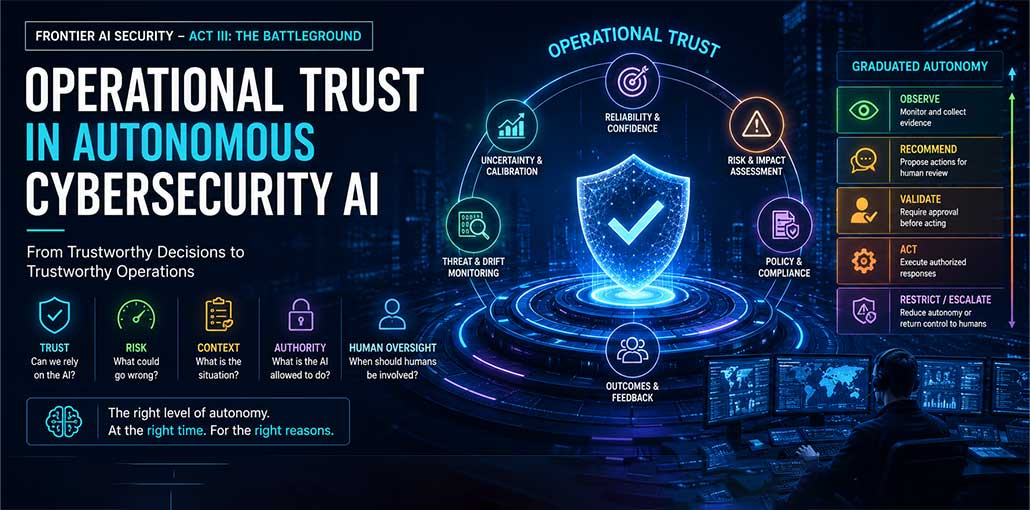
Operational trust requires autonomy to be dynamic, not fixed. The authority granted to an AI system should continuously reflect its trustworthiness, operational risk, and context. This creates graduated autonomy, where increasing trust enables greater authority, while declining trust progressively restricts autonomous action.
A practical autonomy spectrum may include:
- Observe: monitor and collect evidence without acting.
- Recommend: propose actions for human execution.
- Validate: require human or secondary approval before acting.
- Act: execute authorized responses within predefined boundaries.
- Restrict or Escalate: reduce autonomy or transfer authority when trust deteriorates or risk becomes unacceptable.
Autonomy must also be reversible. Changes in uncertainty, adversarial conditions, or unexpected outcomes should allow the system to move from autonomous execution back toward validation, recommendation, or human control.
The objective is therefore not to maximize autonomy, but to provide the appropriate level of autonomy for the current level of trust and risk. Intelligence determines what action may be appropriate; operational trust determines how much authority AI should have to execute it.
Runtime Trust Monitoring
Operational trust cannot be established once and assumed to remain valid. As threats, system conditions, user behavior, and adversarial strategies evolve, the conditions supporting autonomous decisions may change. Trust must therefore be continuously reassessed during operation.
Runtime trust monitoring evaluates whether the conditions justifying an AI system’s current level of autonomy remain valid. Relevant indicators may include:
- prediction reliability and calibration,
- uncertainty and confidence trends,
- behavioral and distribution drift,
- adversarial indicators,
- reasoning and explanation consistency,
- operational context and asset criticality,
- policy compliance,
- and outcomes of previous autonomous actions.
These indicators must remain context-aware. A change in uncertainty may be acceptable for low-risk monitoring but unacceptable before a high-impact autonomous response. Likewise, each action’s outcome provides new evidence to reassess trust and adjust autonomy.
Runtime trust monitoring therefore creates a continuous feedback loop between decision, action, outcome, and trust reassessment, ensuring that an AI system’s authority remains justified as operational conditions evolve.
Controllable Autonomy and Safe Intervention
Greater autonomy requires stronger operational control. AI systems should operate within clearly defined authorization boundaries that determine which actions they may execute, which assets they may affect, and when additional approval is required. Trustworthy autonomy must therefore also be controllable autonomy.
When operational trust deteriorates, the system should progressively restrict its authority rather than continue autonomously until failure. Safe intervention mechanisms may include:
- limiting or suspending autonomous actions,
- requiring secondary validation,
- escalating high-impact decisions to humans,
- activating fallback procedures,
- rolling back inappropriate actions,
- enabling emergency human override,
- and maintaining complete audit trails.
Human override and rollback should be architectural capabilities, allowing operators to regain control and reverse unintended actions when trust or risk exceeds acceptable boundaries.
A central principle therefore emerges: trustworthy autonomy requires the ability to reduce autonomy. Safe autonomous AI must know not only when it is permitted to act independently, but also when it should restrict or stop that independence.
Human–AI Operational Collaboration
Operational trust does not remove humans from cybersecurity decision-making. Instead, it requires determining when machine autonomy is appropriate and when human judgment is necessary. Requiring approval for every action limits autonomous defense, while unrestricted AI authority can introduce unacceptable operational risk.
Human involvement should therefore adapt to trust, uncertainty, risk, and potential consequences. When trust is high and impact is limited, AI may operate autonomously within predefined boundaries. As uncertainty or operational risk increases, greater human involvement may be required, particularly for high-impact or irreversible actions.
This creates a dynamic human–AI control relationship. AI can monitor activity, correlate evidence, and execute time-sensitive responses, while humans provide contextual judgment, strategic oversight, and authorization when decisions exceed established autonomy boundaries. Clear escalation, override, accountability, and control-transfer mechanisms must support this collaboration.
Human oversight therefore becomes an adaptive control mechanism rather than a permanent checkpoint. Decision authority can shift between AI and humans as operational conditions change, laying the foundation for ensuring autonomous cybersecurity remains aligned with human and organizational objectives.
Also read: Frontier AI Security: From Prediction to Trustworthy Intelligence Act II — The Cognitive Shift
Toward Operationally-Aware AI
Autonomous cybersecurity requires AI systems to understand not only threats, uncertainty, and failure, but also the operational context of their own decisions. A technically appropriate action may still be inappropriate if the system lacks sufficient trust, authority, evidence, or contextual understanding.
This capability defines Operationally-Aware AI: cybersecurity intelligence that continuously evaluates its reliability, risk, operational context, authorization boundaries, and appropriate level of autonomy before translating intelligence into action. It connects what AI knows with what it is permitted and prepared to do.
An operationally-aware system should continuously ask:
- What do I know? — Is the evidence sufficient?
- How trustworthy is my decision? — Are reliability and uncertainty acceptable?
- What is the operational risk? — What happens if I am wrong?
- What am I authorized to do? — Is the action within established boundaries?
- Should I act autonomously? — Do trust, risk, and context justify action?
- Should I defer or escalate? — Is human intervention required?
Operationally-Aware AI therefore enables context-sensitive self-regulation, allowing authority to expand, contract, or transfer to humans as conditions change. The objective is not maximum independence, but the right level of autonomy at the right time and under the right conditions.
Yet reliable and properly authorized actions may still diverge from human intent or organizational priorities. Determining what autonomous AI should pursue, and who defines those boundaries, introduces the next stage: Alignment-Aware AI.
Conclusion
As cybersecurity AI becomes increasingly autonomous, trust must extend beyond reliable prediction into operational action. Operational trust connects reliability, uncertainty, risk, context, and authorization to determine when AI should act autonomously, when its authority should be restricted, and when control should return to human operators.
This evolution gives rise to Operationally-Aware AI: systems that continuously assess whether they possess sufficient trust, evidence, authority, and contextual understanding to translate intelligence into action. The objective is not maximum autonomy, but the right level of autonomy under the right operational conditions.
Yet operationally trustworthy AI may still pursue objectives that diverge from human intent or organizational priorities. The next question therefore becomes: Who determines what autonomous cybersecurity AI should ultimately pursue? This moves us from Operationally-Aware AI → Alignment-Aware AI, setting the stage for the next article, Human-Aligned vs Machine-Autonomous Cybersecurity.









Leave a comment