

Tencent’s latest annual results highlight a broader shift in how the company is applying AI across its business. Rather than framing AI as a standalone technology bet, the company is increasingly positioning it as part of how its core operations evolve.
Over the past year, management has pointed to AI making tangible contributions across performance advertising, evergreen games, user engagement and internal productivity. This signals a move away from pure capability-building and toward more practical, revenue-linked applications.
That shift is important because Tencent’s position in AI appears to depend less on competing for the most advanced standalone model, and more on how effectively it can apply AI within products that already operate at scale. Over the past year, the company has continued to expand its AI organization, introduce new talent, and extend its product portfolio across Yuanbao, ima, QQ Browser and Sogou Input Method, while continuing to iterate on the Hunyuan model family.
The level of investment supports this direction. In 2025, Tencent reported capital expenditure of RMB 79.2 billion and R&D spending of RMB 85.75 billion, both record highs. Rather than being concentrated in a single area, this spending reflects a broader buildout across infrastructure, model development, talent and product integration.
This approach becomes more visible when looking at how Tencent is integrating AI across its existing product ecosystem. The company says Hunyuan is now embedded across a wide range of products and scenarios, including Yuanbao, Tencent Cloud, QQ, Weixin Reading, Tencent Meeting and Tencent Docs. Through Tencent Cloud, it provides multiple model variants alongside capabilities such as image generation, 3D creation, agent development and knowledge-base integration. Its open-source Hunyuan portfolio now spans text, image, video, 3D and voice, with more than 30,000 GitHub stars and over 3 million downloads for the Hunyuan 3D series globally.
If integration defines Tencent’s model strategy, Yuanbao offers a clearer view of how the company is approaching user adoption. The platform has expanded across education, content creation, entertainment and productivity scenarios, covering use cases from quiz generation and writing tools to image editing, meeting support and translation. During the Spring Festival campaign, Tencent reported that Yuanbao’s main event logged more than 3.6 billion draws, while users completed more than 1 billion AI-generated tasks.
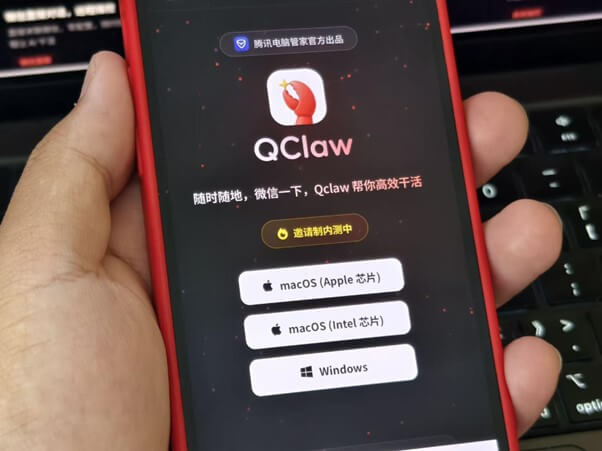
At the same time, Tencent is increasingly emphasizing execution over interaction in its AI roadmap. Its recent agent-related rollout, spanning consumer, developer and enterprise scenarios, reflects a push toward workflow automation, remote task handling and more practical forms of AI assistance. This direction builds on Tencent’s strength in distribution, allowing AI capabilities to be layered onto platforms that users already rely on.
This interpretation is also supported by external analysis. JPMorgan, as cited in Tencent’s materials, noted that competition in China’s AI market may be less about standalone app rankings and more about whether AI can be embedded into existing user workflows. In that context, Tencent’s advantage lies in integrating AI across advertising, content production, enterprise tools and the wider WeChat ecosystem, rather than focusing on a single leading model.
Alongside AI, Tencent’s results also highlight overseas growth as an important second pillar. Gaming remains the clearest example. The company’s international games business has posted multiple quarters of strong growth, driven by titles such as PUBG MOBILE and contributions from Supercell. According to the company’s materials, international games revenue reached RMB 58 billion in 2024, accounting for roughly 30% of total gaming revenue. In 2025, quarterly performance continued to strengthen, with RMB 16.6 billion in Q1 (+23% YoY), RMB 18.8 billion in Q2 (+35%) and RMB 20.8 billion in Q3 (+43%), marking the first time the segment exceeded RMB 20 billion in a single quarter.
Cloud is emerging as another important international growth driver. Tencent Cloud said in March that it would add a new availability zone in Frankfurt, Germany. The company reports that its international cloud business has maintained double-digit growth, while its overseas customer base doubled year on year in 2025.
Tencent is also extending parts of its AI capabilities globally. On November 26, the company launched the international site for its Hunyuan 3D creation engine and made the API available through Tencent Cloud’s global platform. The engine supports multimodal inputs, including text, images, and sketches, can generate high-quality 3D assets within minutes, and exports to formats compatible with tools such as Unity and Unreal Engine. Tencent also notes that Hunyuan 3D has entered parts of Europe’s creative software ecosystem, with German company Maxon integrating the API into its Cinema 4D application.
Another layer of international expansion comes from WeChat’s cross-border ecosystem. Tencent reports that global cross-border and overseas users accessed mini programs more than 5 billion times in 2025. Mini-program services now cover 100 countries and regions, while WeChat cross-border payments are available in 78 countries and regions and support 36 currencies. Transaction value through mini programs in the second half of 2025 increased by more than 70% year on year.
In that sense, Tencent’s AI strategy may be less about defining a single breakthrough product and more about gradually reshaping how its existing ecosystem operates. The company is investing heavily, embedding AI into products with established distribution, and pairing that approach with continued international expansion.









Leave a comment