

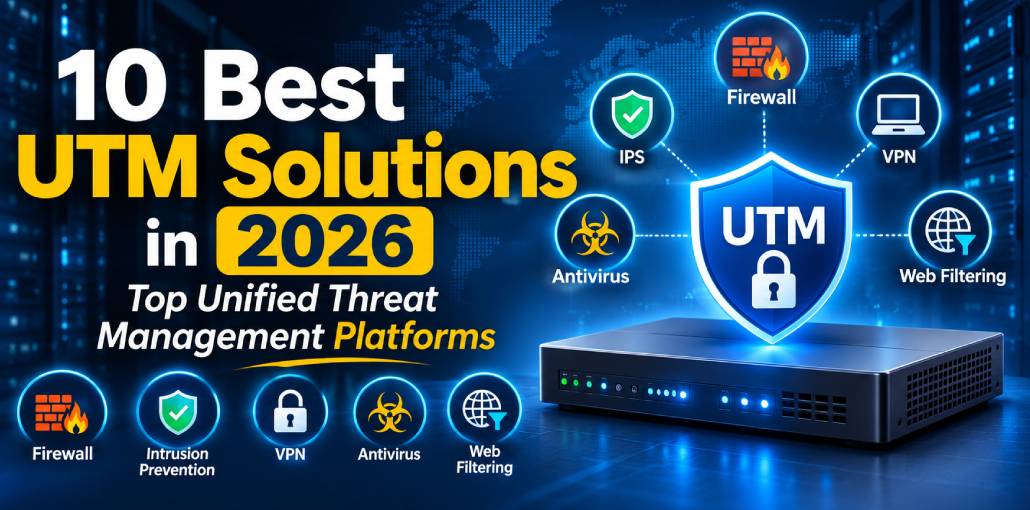
If you want one device that combines firewall, intrusion prevention, virtual private network (VPN), antivirus, and web filtering features without a dedicated security team, Fortinet FortiGate is our top choice for Unified Threat Management (UTM) in 2026. If you are using Sophos endpoint security, then Sophos Firewall could be a good choice too.
What is Unified Threat Management (UTM)?
Unified Threat Management (UTM) combines several network security functions into one appliance or service. This makes life easier for small and medium-sized businesses by reducing administration and providing a unified way to protect your business.
Below, we rank the 10 best UTM solutions based on security capabilities, performance, ease of management, and total cost of ownership.
How We Evaluated
This is not a practical test and is based on research. We evaluated these Unified Threat Management (UTM) solutions based on 5 factors: a centralised security solution (firewall, IPS, VPN, antivirus, Web Filtering), inspected throughput with security services enabled, management simplicity for small IT teams, vulnerability and patch management history, and multi-year costs, including subscription renewals.
Best Unified Threat Management (UTM) Solutions in 2026
1. Fortinet FortiGate — Best UTM Overall
Best for: Organizations of all sizes seeking comprehensive network security, strong performance, and competitive pricing.
Fortinet FortiGate leads our Unified Threat Management (UTM) rankings because of its combination of security features and hardware acceleration. Its purpose-built security processors help supported appliances handle firewalling, intrusion prevention, antivirus, and traffic inspection simultaneously.
FortiGuard subscriptions provide additional protection through IPS, antivirus, web filtering, sandboxing, and DNS security. FortiGate also includes SD-WAN and VPN capabilities, making it suitable for businesses managing multiple offices and remote connections.
Key features:
- NP7 and SP5 security processor acceleration on supported models.
- FortiGuard Unified Threat Protection subscription.
- IPS, antivirus, web filtering, sandboxing, and DNS security.
- IPsec and SSL VPN capabilities.
- Integrated SD-WAN.
- Security Fabric integration with FortiSwitch, FortiAP, and FortiClient.
- Centralized management through FortiGate Cloud and FortiManager.
Pros:
- Strong price-to-performance potential.
- Extensive hardware portfolio.
- Broad security ecosystem.
- Extensive reseller availability.
Cons:
- Advanced features require subscriptions.
- Configuration can be complex for inexperienced administrators.
- Publicly documented vulnerabilities make regular patching essential.
- Security subscription renewals can be expensive.
Pricing: FG-40F hardware pricing has been listed around $300–$700, excluding security subscriptions. Confirm current reseller pricing.
Also read: What is Threat Hunting: 7 Ways to Reduce Risk
2. Sophos Firewall — Best UTM With Endpoint Integration
Best for: SMBs already using Sophos Intercept X or looking for coordinated endpoint and network protection.
Sophos Firewall stands out through its Synchronized Security architecture, which connects firewalls with compatible endpoint protection. Its Security Heartbeat allows endpoints to communicate their security status to the firewall, enabling automated network restrictions when a device is compromised.
The XGS series uses Sophos Xstream architecture to optimize traffic inspection, including TLS inspection. Administrators can also manage supported Sophos products through Sophos Central.
Key features:
- Synchronized Security and Security Heartbeat.
- Automated network isolation for compromised endpoints.
- Xstream TLS inspection and FastPath acceleration.
- Web, application, and content filtering.
- Cloud sandboxing and advanced threat protection.
- Sophos Central management.
- Zero-touch deployment options.
Pros:
- Strong endpoint integration.
- Automated threat containment.
- Centralized management.
- MSP-friendly administration.
- Trial availability.
Cons:
- Delivers the greatest value within the Sophos ecosystem.
- Advanced capabilities require subscriptions.
- Less suited to some large-scale enterprise environments.
Pricing: Quote-based through authorized partners. Check current trial and subscription terms.
3. WatchGuard Firebox — Best UTM for MSPs
Best for: Small businesses and managed service providers handling multiple customer networks.
WatchGuard Firebox combines network security services with centralized management tools designed for MSP environments. Its Total Security Suite bundles capabilities such as intrusion prevention, sandboxing, DNS filtering, and advanced threat protection.
WatchGuard Cloud provides multi-tenant management, allowing service providers to monitor and administer multiple Firebox deployments through a centralized interface.
Key features:
- Total Security Suite licensing.
- IPS and application control.
- APT Blocker sandboxing.
- WatchGuard Cloud multi-tenant management.
- ThreatSync security event correlation.
- AuthPoint MFA integration.
- Multiple appliance options, including T115-W, T125, T145, and T185.
Pros:
- Useful MSP management tools.
- Consolidated security licensing.
- Centralized monitoring.
- Suitable for SMB deployments.
Cons:
- Limited scalability for some enterprise environments.
- Smaller appliances have lower inspection throughput.
- Advanced features may require additional subscriptions.
Pricing: Quote-based through authorized resellers and MSP partners.
4. SonicWall TZ/NSa — Best Budget UTM
Best for: Cost-conscious small businesses and branch offices.
SonicWall TZ and NSa appliances offer firewall protection and advanced threat detection across different hardware price categories. Its Real-Time Deep Memory Inspection (RTDMI) technology analyzes suspicious code behavior in memory to help identify evasive malware.
SonicWall also provides Capture Advanced Threat Protection (ATP), which adds cloud-based sandboxing and malware analysis. Combined with IPS, web filtering, and application control, these capabilities make SonicWall a competitive option for SMB networks.
Key features:
- RTDMI memory inspection.
- Capture ATP cloud sandboxing.
- IPS and application control.
- TLS inspection on supported Gen 7 models.
- Integrated SD-WAN and VPN.
- Network Security Manager.
- Wireless-integrated TZ models.
Pros:
- Competitive hardware options.
- Advanced malware detection.
- Broad SMB feature coverage.
- Established reseller network.
Cons:
- Management experience can be less intuitive.
- Advanced protection requires subscriptions.
- Firmware vulnerabilities require prompt patching.
Pricing: TZ470 pricing has been listed around $1,015 for hardware-only configurations and approximately $1,764 with a one-year TotalSecure package. Verify current pricing.
5. Check Point Quantum Spark — Best UTM for Regulated SMBs
Best for: Smaller organizations in finance, healthcare, and legal services that need advanced threat prevention.
Check Point Quantum Spark brings security technologies from Check Point’s enterprise portfolio into appliances designed for smaller organizations. Its security stack combines firewall protection with IPS, antivirus, anti-bot protection, URL filtering, and advanced threat prevention.
ThreatCloud AI provides threat intelligence to help identify malicious activity and improve detection across connected gateways.
Key features:
- ThreatCloud AI threat intelligence.
- IPS, antivirus, anti-bot, and URL filtering.
- Advanced threat prevention and sandboxing options.
- Local and cloud-based management.
- VPN connectivity.
- Integrated Wi-Fi and cellular failover on selected models.
Pros:
- Strong threat prevention capabilities.
- Enterprise security technology for SMBs.
- Established VPN features.
- Suitable for security-conscious organizations.
Cons:
- Can cost more than entry-level UTM alternatives.
- Licensing requires careful evaluation.
- Smaller MSP channel in some markets.
Pricing: Quote-based, depending on appliance model and security subscription.
6. Barracuda CloudGen Firewall — Best UTM for Multi-Site Networks
Best for: Organizations managing multiple branch offices and cloud-connected networks.
Barracuda CloudGen Firewall combines traditional Unified Threat Management (UTM) capabilities with SD-WAN, traffic optimization, and centralized branch management. Its zero-touch deployment features simplify provisioning across multiple locations.
The platform also supports advanced threat protection and cloud deployment options, including Microsoft Azure environments.
Key features:
- Firewall and intrusion prevention.
- Integrated SD-WAN and traffic shaping.
- Advanced Threat Protection sandboxing.
- Zero-touch branch deployment.
- Centralized Firewall Control Center.
- Application-aware traffic management.
- Azure Marketplace deployment options.
Pros:
- Designed for distributed networks.
- Useful SD-WAN capabilities.
- Centralized administration.
- Flexible physical and cloud deployment.
Cons:
- Smaller independent testing footprint.
- Less common in some security markets.
- May be excessive for single-office businesses.
Pricing: Quote-based for physical deployments, with cloud consumption options depending on configuration.
7. Cisco Meraki MX — Best Cloud-Managed UTM
Best for: Distributed organizations with limited on-site IT resources.
Cisco Meraki MX appliances are managed through the Meraki cloud dashboard, allowing administrators to configure security policies, monitor network activity, manage firmware, and deploy templates across multiple locations.
The Advanced Security license adds intrusion prevention, content filtering, and malware protection supported by Cisco Talos threat intelligence. Meraki Auto VPN also simplifies secure connectivity between branch offices.
Key features:
- Centralized cloud dashboard.
- Configuration templates for multiple sites.
- Talos-backed threat intelligence.
- Snort-based intrusion prevention.
- Content filtering and malware protection.
- Auto VPN site-to-site connectivity.
- Integration with Meraki switches and access points.
Pros:
- Simple cloud management.
- Efficient multi-site deployment.
- Centralized monitoring.
- Strong Meraki ecosystem integration.
Cons:
- Requires active licensing for continued access to licensed services.
- Recurring costs can increase.
- Less granular control than traditional firewall platforms.
Pricing: Hardware and subscription costs vary by model and license tier. Verify current MX licensing options with Cisco partners.
8. HPE Juniper SRX Branch — Best UTM for Juniper Networks
Best for: Organizations already using Juniper networking infrastructure.
HPE Juniper SRX branch gateways combine firewall protection, routing, intrusion prevention, and additional security services. Running Junos OS, they provide a consistent networking environment for organizations already familiar with Juniper products.
Depending on the model and licensing, available services include anti-malware, web filtering, content filtering, and advanced threat prevention.
Key features:
- Stateful firewall protection.
- IPS and application security.
- UTM services on supported configurations.
- Advanced Threat Prevention.
- Junos OS routing.
- Security Director Cloud management.
- Network automation capabilities.
Pros:
- Combines routing and security.
- Strong networking capabilities.
- Useful automation.
- Suitable for established Juniper environments.
Cons:
- More complex than typical SMB UTM appliances.
- Licensing varies by model.
- Smaller standalone SMB market.
Pricing: Quote-based through HPE Juniper partners.
9. Zyxel USG FLEX — Best UTM for Very Small Offices
Best for: Micro-businesses and small offices with limited IT budgets.
Zyxel USG FLEX appliances offer firewall protection, IPS, application control, content filtering, and additional threat protection services at accessible price points.
The platform supports local administration and Nebula cloud management on compatible models. Selected FLEX H appliances also provide additional networking and security capabilities.
Key features:
- Firewall and intrusion prevention.
- Application Patrol.
- Content filtering and anti-malware.
- Sandboxing options.
- Nebula cloud management.
- SSL inspection and SD-WAN on supported models.
- Integrated networking capabilities.
Pros:
- Affordable hardware options.
- Useful SMB security features.
- Flexible management.
- Suitable for smaller offices.
Cons:
- Limited enterprise scalability.
- Advanced threat research capabilities may be less extensive than larger competitors.
- Firmware updates require regular attention.
Pricing: Generally positioned in the lower-cost Unified Threat Management (UTM) segment. Confirm current hardware and subscription pricing with resellers.
Also read: 10 Best Cyber Threat Intelligence Tools
10. Arista Edge Threat Management NG Firewall (Untangle) — Best UTM Software
Best for: Budget-conscious organizations deploying Unified Threat Management (UTM) software on existing hardware or virtual infrastructure.
Formerly known as Untangle NG Firewall, Arista Edge Threat Management NG Firewall takes a modular, software-based approach to network security.
The platform can run on compatible x86 hardware or virtual machines, allowing organizations to deploy firewall protection, IPS, VPN, web filtering, and bandwidth management without purchasing a dedicated proprietary appliance.
However, businesses evaluating the platform should review product lifecycle announcements, subscription availability, and long-term support requirements before deployment.
Key features:
- Modular firewall and security applications.
- Web filtering and intrusion prevention.
- VPN connectivity.
- Bandwidth management.
- Deployment on compatible x86 hardware or VMs.
- Flexible software licensing.
Pros:
- Flexible deployment.
- Can use existing hardware.
- Modular security features.
- Accessible management interface.
Cons:
- Hardware product lifecycle changes require attention.
- Support and subscription availability should be verified.
- Some legacy entitlements have end-of-support considerations.
Pricing: Subscription-based software licensing. Confirm current availability and support terms with Arista.
Final Verdict
Selecting the best Unified Threat Management (UTM) solution for 2026 is critical to securing your network from evolving cyber threats. My choice is Fortinet FortiGate, while Sophos, WatchGuard, and SonicWall also offer some great options. Whether you’re a small business or an expanding enterprise, take a look at our list of the top 10 Unified Threat Management (UTM) solutions to see which one will be the best fit for you.
FAQs: Unified Threat Management (UTM) Solutions
What is a Unified Threat Management (UTM) solution?
A Unified Threat Management solution is a network security platform that combines multiple security features, such as firewall protection, antivirus, intrusion prevention, VPN, and web filtering, into one system.
What are the best Unified Threat Management solutions in 2026?
Some leading UTM solutions include Fortinet FortiGate, Sophos Firewall, WatchGuard Firebox, SonicWall, Check Point Quantum Spark, and Cisco Meraki MX.
What is the difference between UTM and NGFW?
UTM combines multiple security functions into one platform, while a Next-Generation Firewall (NGFW) focuses primarily on advanced firewall capabilities, application awareness, and threat prevention. Modern products often overlap.
What is the difference between UTM hardware and UTM software?
Unified Threat Management hardware is a physical security appliance installed within a network. Unified Threat Management software provides similar security functions through virtual machines, cloud platforms, or software-based deployments.







Leave a comment