

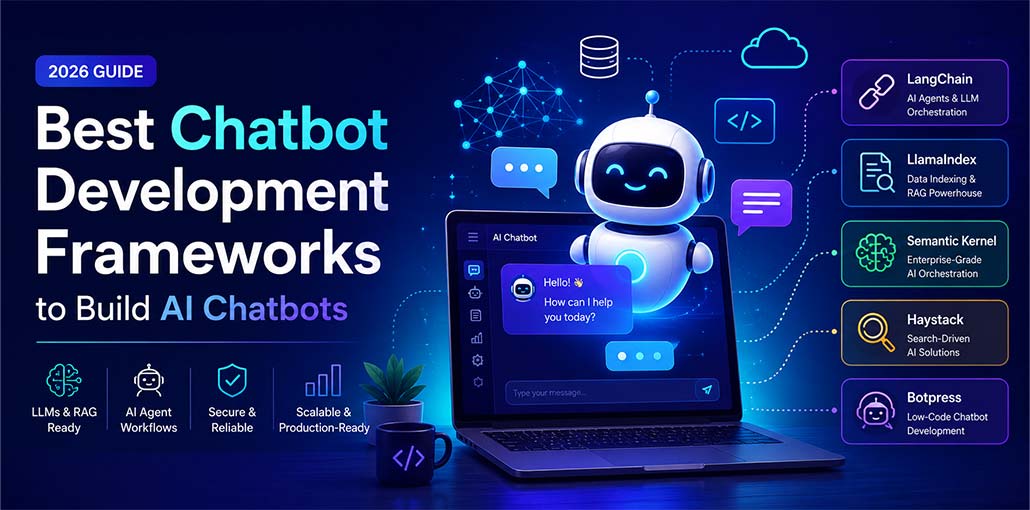
It’s easy to select the chatbot development frameworks.
If you Google it, you’ll find these chatbot development frameworks. Check this out and follow your guide.
It worked perfectly… up until LLMs came in and completely flipped the entire dynamic.
The NLP-heavy approach now feels somewhat… old-fashioned.
Here’s my experience. I tried about 10 chatbot development frameworks. And out of them, I’ve picked the five best chatbot development frameworks.
I’ve tried them extensively, I’ve spoken to developers who’ve used them, and shared my honest thoughts on them in this blog.
What Are Chatbot Development Frameworks & What’s Changed in 2026?
A chatbot development framework is an infrastructure that runs underneath your chatbot. It takes care of these issues,
- Your fundamental NLP
- Intent recognition
- Dialogue management
- Channel deployment
- Integrations into your current tools.
Without an infrastructure, you’ll have to build everything completely from scratch. No one would want to make that effort.
What actually did 2026 change?
The simple answer is: LLMs are now smarter, and more businesses are using them to make everything feasible.
That’s it… to date, they were rule-based or NLP-first. It was effective; however, it was not very flexible. It was also difficult to deal with edges.
Modern frameworks are increasingly focused on reasoning and understanding context.
Additionally, it has established a basis for some basic expectations, which makes developing chatbots simpler. (I’ve provided them below)
- Retrieval-Augmented Generation (RAG) is now the standard. Chatbots extract information from your information base before generating an answer.
- Hallucination control and AI guardrails are critical, particularly for things facing customers.
- Graph-based AI orchestration is replacing traditional workflows. Bots can now loop, retry, or perform tasks in parallel, instead of following rigid A-B tree structures.
- Chatbots are becoming proactive. For instance, it might detect a shipment delay and share an update before the customer even asks
- Businesses require greater control and visibility. This includes things like auditability, logging, and role-based access.
This is the context you must consider before deciding on one.
You may also look through these chatbot suggestions to see how companies are improving their chatbots.
5 Best Chatbot Development Frameworks
Developing chatbots was difficult earlier. However, thanks to giant technology firms like Google, Microsoft, Facebook, and IBM, creating chatbots has become a lot easier, with the best chatbot development frameworks.
1. LangChain
LangChain is one of the most popular Chatbot Development Frameworks in 2026, designed for building AI-powered chatbots and intelligent agents. It supports Retrieval-Augmented Generation (RAG), memory, tool integration, and multi-agent workflows. With extensive integrations and support for leading large language models, LangChain enables developers to create scalable, production-ready conversational AI applications efficiently.
Key Features
- LLM orchestration
- Agent workflows
- Retrieval-Augmented Generation (RAG)
- Memory management
- Tool calling
- Vector database integrations
- Multi-model support
Pros
- Extensive documentation
- Massive developer community
- Hundreds of integrations
- Production-ready architecture
- Cons
- Steeper learning curve
- Rapid updates may require code adjustments
Ideal Use Cases
- AI assistants
- Customer support bots
- Enterprise knowledge assistants
- Autonomous AI agents
Also read: Beta Character AI: Everything You Need to Know About Character AI Chatbots
2. LlamaIndex
LlamaIndex is among the best Chatbot Development Frameworks for creating knowledge-based AI chatbots. It simplifies connecting chatbots with PDFs, databases, APIs, and enterprise documents using advanced indexing and retrieval techniques. Its strong RAG capabilities and seamless data integration make it an ideal framework for businesses developing intelligent document-aware conversational assistants.
Key Features
- Advanced document ingestion
- Efficient indexing
- Vector search
- Knowledge graph integration
- Data connectors
- RAG optimization
Pros
- Excellent retrieval performance
- Easy document integration
- Flexible indexing options
Cons
- Less focused on complex agent orchestration
Ideal Use Cases
- Internal knowledge assistants
- Legal document chatbots
- HR assistants
- Technical documentation bots
3. Microsoft Semantic Kernel
Microsoft Semantic Kernel is a powerful choice among Chatbot Development Frameworks for enterprise AI applications. It provides advanced orchestration, plugin support, memory management, and AI planning features while integrating seamlessly with Azure services. Developers can build secure, scalable chatbots that automate business processes and deliver intelligent conversational experiences across enterprise environments.
Key Features
- AI planning
- Function calling
- Plugin architecture
- Memory support
- Multi-language SDKs
- Enterprise security
Pros
- Excellent Azure integration
- Strong governance
- Scalable architecture
Cons
- Best suited for Microsoft-centric environments
Ideal Use Cases
- Enterprise copilots
- Internal productivity tools
- Business process automation
- Corporate AI assistants
4. Haystack
Haystack is one of the leading Chatbot Development Frameworks for building search-driven and Retrieval-Augmented Generation (RAG) applications. It offers semantic search, hybrid retrieval, document indexing, and modular pipelines to improve chatbot accuracy. Haystack is widely used for enterprise knowledge management, question-answering systems, and AI assistants that rely on reliable information retrieval.
Key Features
- Hybrid search
- Semantic search
- Document stores
- Evaluation tools
- Modular pipelines
- Multiple retriever support
Pros
- Strong RAG capabilities
- Flexible architecture
- Mature production ecosystem
Cons
- Smaller community compared to LangChain
Ideal Use Cases
- Knowledge management
- Enterprise search
- FAQ automation
- Research assistants
Also read: Top 10 Backend Frameworks For Web Development
5. Botpress
Botpress is a modern Chatbot Development Framework that combines low-code development with AI-powered capabilities. Its visual workflow builder, multi-channel deployment, analytics, and knowledge base integration enable businesses to create customer support and virtual assistant chatbots quickly. Botpress is ideal for organizations seeking fast chatbot deployment without extensive programming expertise.
Key Features
- Visual conversation builder
- AI-powered workflows
- Multi-channel deployment
- Built-in analytics
- Knowledge base integration
Pros
- Easy to learn
- Fast deployment
- Business-friendly interface
Cons
- Less customizable than developer-first frameworks
Ideal Use Cases
- Customer service
- Lead generation
- FAQ bots
- Website assistants
How to Choose the Right Chatbot Development Frameworks
| Factor | What to Consider |
|---|---|
| Project Requirements | Identify whether you need a customer support bot, AI assistant, or RAG-based chatbot. |
| Ease of Use | Choose a framework with simple documentation and an easy learning curve. |
| AI & LLM Support | Ensure it supports popular AI models like OpenAI, Gemini, Claude, or open-source LLMs. |
| Scalability | Select a framework that can handle increasing users and business growth. |
| Integration | Check compatibility with APIs, databases, CRMs, and third-party tools. |
| Customization | Look for flexible workflows and features to meet your business needs. |
| Community & Support | Prefer frameworks with active communities, regular updates, and good documentation. |
| Budget | Compare free, open-source, and paid options based on your project budget. |
Conclusion
Choosing the right Chatbot Development Frameworks is essential for building intelligent, scalable, and efficient AI applications. Whether you prefer LangChain, LlamaIndex, Microsoft Semantic Kernel, Haystack, or Botpress, each framework offers unique strengths. Evaluate your project requirements, technical expertise, and business goals to select the best solution for success in 2026.
FAQs: Chatbot Development Frameworks
What are Chatbot Development Frameworks?
Chatbot Development Frameworks are software platforms that help developers build, train, and deploy AI-powered chatbots with features like natural language processing, integrations, and automation.
Which is the best Chatbot Development Framework in 2026?
LangChain is widely considered one of the best Chatbot Development Frameworks in 2026 due to its advanced AI capabilities, extensive integrations, and support for AI agents and RAG applications.
Which Chatbot Development Framework is best for beginners?
Botpress is a great choice for beginners because it offers a visual interface, low-code development, and easy deployment for creating AI chatbots.
Which framework is best for AI agents?
LangChain is widely regarded as one of the strongest frameworks for building AI agents thanks to its orchestration, memory, and tool integration capabilities.








Leave a comment