

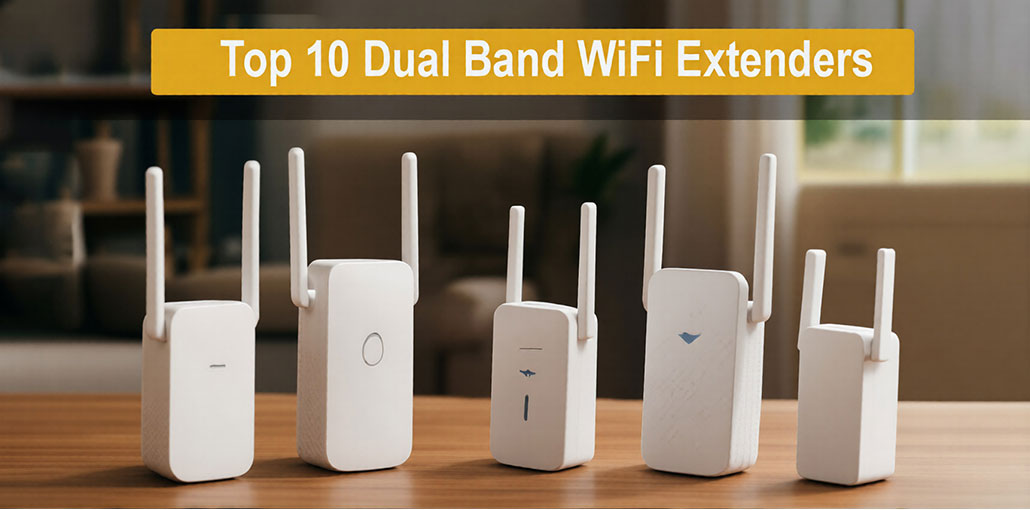
Are you looking for a reliable dual band WiFi extender to provide a strong signal and connectivity in your home? Look no further – here you are at the right place!
Dual-band WiFi can offer better speeds and priority for devices compared to single-band. However, with the vast number of range extenders supporting dual-band WiFi, choosing the best option can be difficult.
So, I picked 20 top dual band WiFi extenders and tried each one in a variety of ways, and analyzed their features and performance to make sure you don’t end up with a device. Without further delay, let’s get to the details.
Top 10 Best Dual Band WiFi Extenders
Before I begin reviewing the models, I’d like to note that I tested these dual band WiFi extenders in my office and home for four weeks.
The tests are conducted across a range of aspects, including speed, coverage, and device-handling capacity. Therefore, you can trust them and select the option below that meets your needs and budget.
1. TP-Link RE715X — Best Dual Band WiFi Extender Overall
The TP-Link RE715X is our top pick for the best dual band WiFi extender because it combines WiFi 6 performance, high theoretical speeds, mesh support, and a Gigabit Ethernet port.
It is an AX3000 dual-band WiFi 6 extender, with up to 574 Mbps on 2.4GHz and 2,402 Mbps on 5GHz. It also supports 160MHz channels on the 5GHz band, OFDMA, MU-MIMO, beamforming, and adaptive path selection.
One of its biggest advantages is EasyMesh compatibility. When paired with a compatible router, it can become part of a mesh network designed for more seamless whole-home coverage.
The RE715X also supports access point mode. Instead of connecting wirelessly to the router, you can connect it through Ethernet and use it to create a WiFi access point.
Why we like it:
- AX3000 WiFi 6 performance
- 574 Mbps + 2,402 Mbps theoretical dual-band rates
- 160MHz 5GHz support
- EasyMesh compatibility
- Gigabit Ethernet port
- Access Point mode
- MU-MIMO and beamforming
- Tether app for setup and management
Best for: Homes with multiple connected devices, streaming, gaming, and users who want a modern WiFi 6 extender.
Bottom line: If you want one well-rounded dual band WiFi extender for a modern home network, the RE715X is an excellent place to start.
Also read: Best WiFi Extender for Gaming: 5 Picks for Fast Speed
2. ASUS RP-AX58 — Best for ASUS AiMesh Networks
The ASUS RP-AX58 is another strong choice if you want WiFi 6 performance and already use an ASUS router.
This dual-band WiFi 6 range extender is rated AX3000, with up to 574 Mbps on 2.4GHz and 2,402 Mbps on 5GHz. It supports ASUS AiMesh, allowing compatible ASUS routers and networking devices to work together as a mesh system.
The RP-AX58 also includes a Gigabit Ethernet port and can operate in range extender, access point, or media bridge modes.
Its AiMesh support is the biggest reason to consider it. If you already have a compatible ASUS router, integrating the extender into the same ecosystem can be more attractive than buying a standalone extender from another brand.
Why we like it:
- AX3000 WiFi 6
- Up to 2,402 Mbps on 5GHz
- Up to 574 Mbps on 2.4GHz
- ASUS AiMesh support
- Gigabit Ethernet
- Access point and media bridge modes
- WPA3 support
Best for: ASUS router owners and users who want a WiFi 6 mesh setup.
Bottom line: The RP-AX58 is a particularly compelling dual band WiFi extender for an ASUS-based network.
3. TP-Link RE650 — Best High-Speed WiFi 5 Extender
If you don’t necessarily need WiFi 6, the TP-Link RE650 remains an interesting high-performance option.
The RE650 uses WiFi 5 technology and offers an AC2600 dual-band connection, with up to 800 Mbps on 2.4GHz and 1,733 Mbps on 5GHz. It also uses four external antennas and supports 4×4 MU-MIMO and beamforming.
A Gigabit Ethernet port lets you connect wired devices such as gaming consoles, computers, or smart TVs. It can also operate in access point mode.
TP-Link’s OneMesh compatibility can be useful with compatible TP-Link routers, allowing the extender to participate in a mesh network.
Why we like it:
- AC2600 dual-band WiFi
- 800 Mbps + 1,733 Mbps theoretical rates
- Four external antennas
- 4×4 MU-MIMO
- Beamforming
- Gigabit Ethernet
- Access Point mode
- OneMesh support
Best for: Users who want strong WiFi 5 performance without necessarily moving to WiFi 6.
Bottom line: The RE650 is an older-generation option, but its high AC-class rating and 4×4 design make it worth considering for compatible setups.
4. Linksys RE7350 — Best WiFi 6 Extender for Coverage
The Linksys RE7350 is a dual-band WiFi 6 range extender designed to increase coverage and support more connected devices.
It is rated AX1800 and operates on both 2.4GHz and 5GHz bands. Linksys lists features including beamforming, Cross-Band technology, Spot Finder, and support for wired access point mode.
The Spot Finder feature can help users determine whether the extender is positioned appropriately relative to the router. That’s particularly useful because extender placement has a major effect on performance.
Cross-Band technology is designed to use both wireless bands simultaneously for high-speed data transfer and applications such as streaming and gaming.
Why we like it:
- WiFi 6 technology
- Dual-band 2.4GHz and 5GHz operation
- AX1800 class
- Beamforming
- Cross-Band technology
- Spot Finder for placement
- Access point support
- WPA3 security support
Best for: Users looking for a straightforward WiFi 6 extender with useful placement and connectivity features.
Bottom line: The RE7350 is a solid choice if your priority is extending WiFi 6 coverage without moving to a more expensive mesh system.
5. Tenda A33 — Best High-Speed Budget WiFi 6 Extender
The Tenda A33 brings WiFi 6 and AX3000-class performance to the dual-band extender category.
It is designed to deliver up to 2,402 Mbps on 5GHz and 574 Mbps on 2.4GHz. Tenda also uses high-gain external antennas and high-performance front-end modules to improve wireless transmission and reception.
The A33 is especially interesting for people who want high theoretical wireless speeds but don’t necessarily want to pay for a premium mesh system.
An Ethernet port also provides another way to connect devices or use the extender with a wired network configuration.
Why we like it:
- AX3000 WiFi 6
- 2.4GHz and 5GHz bands
- Up to 2,402 Mbps on 5GHz
- High-gain external antennas
- Gigabit Ethernet connectivity
- Designed for larger homes
Best for: Users looking for a high-speed WiFi 6 extender at a potentially lower price than premium alternatives.
Bottom line: The Tenda A33 is worth considering when speed and WiFi 6 features are high on your list.
6. NETGEAR EX6120 — Best Compact Budget Pick
The NETGEAR EX6120 is designed for people who want a simple way to expand WiFi coverage without moving to a larger, more expensive system.
It is an AC1200 dual-band WiFi 5 extender, with up to 300 Mbps on 2.4GHz and 900 Mbps on 5GHz. NETGEAR also includes external antennas and a wired Ethernet port.
One interesting feature is FastLane technology, which can use both WiFi bands to establish a high-speed connection between the router and extender.
The EX6120 can also work as an access point, making it more flexible than a basic repeater.
Why we like it:
- AC1200 dual-band WiFi
- 2.4GHz and 5GHz support
- External antennas
- FastLane technology
- Ethernet port
- Access point mode
- Simple setup
Best for: Smaller homes and users who want a compact, straightforward WiFi upgrade.
Bottom line: If you don’t need WiFi 6, the EX6120 can be a practical dual band WiFi extender for basic coverage improvements.
Also read: Best Modem Router Combo (2026 Buyer’s Guide)
7. TP-Link RE550 — Best Value WiFi 5 Extender
The TP-Link RE550 is a WiFi 5 dual-band extender aimed at users who want a combination of coverage, speed, and useful networking features.
It is rated AC1900, offering up to 600 Mbps on 2.4GHz and 1,300 Mbps on 5GHz. TP-Link also lists three adjustable external antennas, a Gigabit Ethernet port, an intelligent signal light, and access point mode.
The intelligent signal light is useful during setup because it helps you determine where the extender should be placed for a stronger connection to the router.
The RE550 is also compatible with EasyMesh on supported versions and compatible routers, making it more versatile than a basic standalone repeater.
Why we like it:
- AC1900 dual-band WiFi
- 600 Mbps + 1,300 Mbps theoretical rates
- Three external antennas
- Gigabit Ethernet
- Access Point mode
- Signal indicator
- EasyMesh support on compatible configurations
Best for: Users looking for a capable WiFi 5 extender with strong connectivity features.
Bottom line: The RE550 is a good value-oriented choice if WiFi 6 isn’t a requirement.
8. NETGEAR EX5000 — Best Simple Budget Option
The NETGEAR EX5000 is another AC1200 dual band WiFi range extender aimed at straightforward home WiFi expansion.
It supports both 2.4GHz and 5GHz networks and uses internal antennas with high-power amplifiers. NETGEAR also includes FastLane technology for using both bands to establish a high-speed connection.
An LED indicator helps users determine a suitable placement location. This matters because an extender should generally be placed where it still receives a reasonably strong signal from the main router—not directly inside the dead zone.
Why we like it:
- AC1200 dual-band WiFi
- 2.4GHz and 5GHz support
- Internal antenna design
- FastLane technology
- Smart LED placement indicator
- Simple setup
Best for: Basic WiFi coverage expansion and users who want a compact extender.
Bottom line: The EX5000 makes sense for users who need additional coverage without requiring advanced WiFi 6 features.
9. TP-Link RE315 — Best Dual Band WiFi Extender for Small Homes
The TP-Link RE315 is an affordable AC1200 dual band wifi extender for home that focuses on simplicity and compatibility.
It supports up to 300 Mbps on 2.4GHz and 867 Mbps on 5GHz. TP-Link also includes Adaptive Path Selection, which automatically chooses a connection path to the router, along with EasyMesh compatibility on supported configurations.
The RE315 has a Fast Ethernet port and can operate in access point mode. It is also designed to work with WiFi routers and wireless access points from different manufacturers.
Why we like it:
- AC1200 dual-band WiFi
- 300 Mbps + 867 Mbps theoretical rates
- EasyMesh compatibility
- Adaptive Path Selection
- Access Point mode
- Smart signal indicator
- Compact design
Best for: Apartments, small homes, bedrooms, and basic dead-zone problems.
Bottom line: The RE315 is a sensible option when you want a simple dual band WiFi extender without paying for premium WiFi 6 hardware.
10. WAVLINK AERIAL HD8S — Best Outdoor Dual Band WiFi Extender
Most WiFi extenders are designed for indoor use. If you need WiFi coverage in a backyard, patio, garden, outdoor workspace, or other exposed location, the WAVLINK AERIAL HD8S is a more specialized option.
The device supports dual-band AC1200 speeds, with up to 300 Mbps on 2.4GHz and 867 Mbps on 5GHz. It uses four detachable 7dBi omnidirectional antennas and supports repeater, access point, mesh router, and mesh extender modes.
The enclosure is rated IP67, and the device supports active and passive Power over Ethernet. These features make it substantially different from a typical plug-in indoor extender.
Why we like it:
- AC1200 dual-band WiFi
- Four 7dBi external antennas
- IP67-rated enclosure
- Gigabit Ethernet
- Active and passive PoE support
- Repeater and access point modes
- Mesh capabilities
Best for: Outdoor WiFi coverage, patios, gardens, detached spaces, and larger open areas.
Bottom line: If your WiFi problem is outside the house, a purpose-built outdoor dual band WiFi extender like this can be a better fit than an indoor plug-in model.
Dual Band WiFi Extender Comparison
| Model | WiFi Generation | 2.4GHz Speed | 5GHz Speed | Ethernet | Best For |
|---|---|---|---|---|---|
| TP-Link RE715X | WiFi 6 | 574 Mbps | 2,402 Mbps | Gigabit | Overall |
| ASUS RP-AX58 | WiFi 6 | 574 Mbps | 2,402 Mbps | Gigabit | AiMesh |
| TP-Link RE650 | WiFi 5 | 800 Mbps | 1,733 Mbps | Gigabit | High-Speed WiFi 5 |
| Linksys RE7350 | WiFi 6 | Dual-Band | Dual-Band | Yes | WiFi 6 Coverage |
| Tenda A33 | WiFi 6 | 574 Mbps | 2,402 Mbps | Gigabit | Value WiFi 6 |
| NETGEAR EX6120 | WiFi 5 | 300 Mbps | 900 Mbps | Fast Ethernet | Budget |
| TP-Link RE550 | WiFi 5 | 600 Mbps | 1,300 Mbps | Gigabit | Value |
| NETGEAR EX5000 | WiFi 5 | Dual-Band | Dual-Band | — | Simple Setup |
| TP-Link RE315 | WiFi 5 | 300 Mbps | 867 Mbps | Fast Ethernet | Small Homes |
| WAVLINK AERIAL HD8S | WiFi 5 | 300 Mbps | 867 Mbps | Gigabit/PoE | Outdoor |
How to Choose the Best Dual Band WiFi Extender
Not sure which model is right for you? Focus on these factors before buying a dual band WiFi extender.
1. WiFi Standard
Look for WiFi 6 (802.11ax) if you have a newer router and many connected devices.
WiFi 5 (802.11ac) can still make sense if you want to save money or your existing network doesn’t support newer standards.
2. Maximum Wireless Speed
Don’t automatically choose the extender with the biggest number on the box.
AX3000, AC2600, AC1900, and AC1200 are theoretical classes, not guarantees of real-world internet speed.
The actual performance you experience can be affected by distance, interference, building materials, router performance, and your connected devices.
3. Ethernet Port
An Ethernet port can be extremely useful.
You can connect a smart TV, PC, game console, or other wired device to the extender. Some models can also use Ethernet for access point mode.
For example, the RE715X includes a Gigabit Ethernet port and access point functionality.
4. Mesh Compatibility
If your router supports EasyMesh, AiMesh, OneMesh, or another compatible mesh technology, look for an extender from the same ecosystem or one with compatible standards.
This can make roaming between network devices more seamless.
5. Placement Features
A good signal indicator can make setup much easier.
The extender should generally receive a strong enough signal from the router to rebroadcast it effectively. Putting the extender at the very edge of your WiFi dead zone may not produce good results.
6. Your Home’s Size and Layout
A small apartment doesn’t necessarily need an expensive AX3000 extender.
A large multi-floor home, thick walls, detached garage, or outdoor area may require more powerful hardware or a different network architecture.
7. Number of Connected Devices
Choose an extender that can handle the number of phones, laptops, TVs, and smart devices connected to your network.
Wrap up
For a modern home that needs better coverage without replacing the entire network, a good dual band WiFi extender can be a practical way to eliminate frustrating WiFi dead zones.
FAQs: Dual Band WiFi Extender
What is a dual band WiFi extender?
A dual band WiFi extender boosts your existing WiFi signal using both 2.4GHz and 5GHz bands, helping improve coverage in areas with weak or unstable WiFi.
Is a dual band WiFi extender better than a single-band extender?
Yes, in most cases. A dual band WiFi extender offers better flexibility, allowing you to use 2.4GHz for range and 5GHz for higher speeds.
Can a dual band WiFi extender work with any router?
Most extenders work with standard WiFi routers, but advanced features such as mesh support may require compatible devices.
How many devices can connect to a dual band WiFi extender?
The number varies by model. For homes with many phones, laptops, TVs, gaming consoles, and smart devices, choose an extender designed to handle multiple simultaneous connections.
Is WiFi 6 better for a dual band WiFi extender?
WiFi 6 is a good choice for newer homes with multiple connected devices, as it offers improved efficiency and performance compared with older WiFi standards.




Leave a comment