

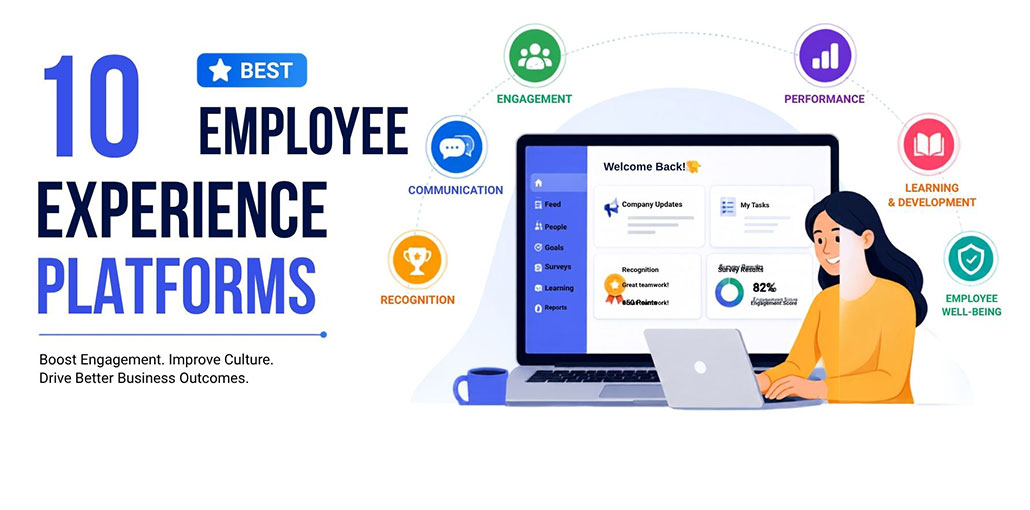
Employee Experience Platforms (EEPs) are designed to boost employee happiness and productivity by streamlining HR processes. It’s a central hub for collaboration, employee resource management, and communication.
Employer Experience Platforms are essential for companies seeking to build better workplace culture, improve decision-making, and invest in talent development. Employer Experience Platforms enable these goals while simultaneously engaging employees, improving business results, and increasing employee satisfaction.
Top 10 Employee Experience Platforms
Here are 10 Employee Experience Platforms (EEPs) to consider in 2026, with their key features, advantages, and disadvantages.
| Platform | Best Use Case | Standout Feature | Best For |
|---|---|---|---|
| Leapsome | Employee growth | Performance, goals & learning | Growing teams |
| Workvivo | Team communication | Social-style employee feed | Remote & hybrid teams |
| Motivosity | Employee recognition | Rewards & peer appreciation | Culture-focused teams |
| WorkTango | Employee listening | Surveys & workforce insights | HR teams |
| Culture Amp | Engagement tracking | Feedback & people analytics | Engagement-focused companies |
| Blink | Frontline communication | Mobile-first employee access | Deskless workers |
| Qualtrics XM | Experience measurement | Advanced employee analytics | Large enterprises |
| Raydiant | Workplace communication | Digital signage | Physical workplaces |
| Cooleaf | Employee appreciation | Rewards & engagement activities | Recognition-focused teams |
| Lattice | Performance & development | Goals, feedback & reviews | Performance-focused teams |
1. Leapsome
Leapsome helps companies enhance employee engagement, performance, learning, and development by setting goals, collecting feedback, and helping employees build new skills.
Leapsome stands out among Employee Experience Platforms as an invaluable solution for businesses that want to manage growth, feedback, and performance from a connected place.
Key Features
- Employee engagement surveys
- Performance management
- Goal setting and tracking
- Learning and development
- Employee feedback
Pros
- Combines several HR tools in one platform
- Useful for employee development
- Helps managers track goals and feedback
Cons
- Can feel complex for beginners
- May be better suited to growing or larger teams
- Some features may require higher plans
Also read: 7 Best Employee Management Software: How to Choose the Right One
2. Workvivo
Workvivo helps employees remain engaged with both their company and colleagues through an online social space where teams can easily share updates, recognize achievements, and communicate. Workvivo stands out among Employee Experience Platforms because its accessibility makes it especially useful for remote or hybrid teams that require simple means to stay informed and connected.
Key Features
- Internal communication
- Employee news feed
- Employee recognition
- Company announcements
- Mobile access
Pros
- Easy way to connect employees
- Good for remote and hybrid teams
- Social-style interface can encourage participation
Cons
- Mainly focused on communication and engagement
- May offer more features than small teams need
- Setup may take time for larger organizations
3. Motivosity
Motivosity focuses on employee recognition, rewards, and the workplace relationships they deserve. Employees can thank coworkers, celebrate achievements, or participate in team-building activities for team culture. Ideal for companies comparing Employee Experience Platforms like Motivosity that want their staff members to feel appreciated while encouraging positive workplace behavior.
Key Features
- Employee recognition
- Rewards
- Peer-to-peer appreciation
- Employee engagement
- Workplace community
Pros
- Makes employee recognition simple
- Encourages employees to appreciate coworkers
- Helps build a positive workplace culture
Cons
- Recognition is its main strength
- May not replace a complete HR system
- Some organizations may need additional tools
4. WorkTango
WorkTango helps companies understand what employees think and feel by offering surveys, feedback tools, recognition features, and people insights. In terms of Employee Experience Platforms, WorkTango stands out as an efficient option for HR departments to collect employee opinions and improve the workplace.
Key Features
- Employee surveys
- Employee feedback
- Recognition
- People analytics
- Employee engagement tools
Pros
- Strong employee listening features
- Helps turn feedback into useful insights
- Combines surveys and recognition
Cons
- Can be more useful for larger organizations
- Some advanced features may take time to learn
- Not every company needs all available tools
5. Culture Amp
Culture Amp is designed to help businesses collect employee feedback and understand workplace engagement by offering surveys, performance tools, and people analytics that show what’s working well and where there may be improvement. Culture Amp is one of the top Employee Experience Platforms that can help companies make decisions regarding employee data.
Key Features
- Employee engagement surveys
- Employee feedback
- People analytics
- Performance management
- Employee development
Pros
- Strong analytics and reporting
- Helps companies understand employee sentiment
- Useful for improving workplace culture
Cons
- Can feel overwhelming for smaller teams
- Advanced features may require training
- Pricing may not suit every budget
6. Blink
Blink is designed mainly for frontline and deskless workers who may not spend their day at a computer. It helps employees access company news, information, and communication from one place. Among Employee Experience Platforms, Blink is a useful choice for businesses that need to keep frontline workers connected.
Key Features
- Frontline communication
- Employee messaging
- Mobile access
- Company updates
- Workplace information
Pros
- Designed for frontline workers
- Helps deskless employees stay connected
- Easy access through mobile devices
Cons
- More focused on frontline teams
- May not be necessary for office-only companies
- Some businesses may need additional HR tools
7. Qualtrics XM
Qualtrics XM helps large organizations understand employee experiences through surveys, feedback, and data analysis. Companies can use it to measure employee sentiment and find areas that need improvement. Among Employee Experience Platforms, Qualtrics XM stands out for its detailed analytics and ability to handle the needs of larger organizations.
Key Features
- Employee surveys
- Experience management
- Sentiment analysis
- Workforce analytics
- Employee feedback
Pros
- Powerful analytics
- Suitable for large organizations
- Provides detailed employee insights
Cons
- Can be complicated for beginners
- May be more than small businesses need
- Implementation can require more planning
8. Raydiant
Raydiant focuses on improving communication inside physical workplaces. Businesses can use digital screens to show company news, announcements, recognition messages, and other useful information. For companies exploring Employee Experience Platforms, Raydiant can be helpful in offices, stores, healthcare facilities, and other locations where employees need quick access to updates.
Key Features
- Digital signage
- Workplace communication
- Employee announcements
- Visual content
- Physical workplace engagement
Pros
- Useful for physical workplaces
- Makes important announcements highly visible
- Supports visual communication
Cons
- Mainly useful for organizations with physical locations
- Not a complete employee management system
- Less useful for fully remote teams
9. Cooleaf
Cooleaf helps companies improve employee recognition, rewards, engagement, and workplace culture. Teams can celebrate achievements while taking part in activities designed to build stronger bonds among team members. Cooleaf stands out among Employee Experience Platforms as an option that allows businesses to recognize employees while creating a more positive workplace atmosphere.
Key Features
- Employee recognition
- Rewards
- Engagement activities
- Employee appreciation
- Workplace culture tools
Pros
- Easy way to recognize employees
- Encourages workplace participation
- Helps build a positive company culture
Cons
- Focuses strongly on recognition and engagement
- May require other HR software
- Some organizations may need more advanced analytics
Also read: How to Boost Employee Morale for A Successful Company
10. Lattice
Lattice’s employee performance platform emphasizes goals, feedback, engagement, and professional development for staff. Managers can set targets, review progress made against those goals, and coach employees as they enhance their skill sets. For businesses comparing Employee Experience Platforms, Lattice can be especially advantageous when employee development and performance management play key roles in their workplace strategy.
Key Features
- Performance management
- Goal setting
- Employee feedback
- Career development
- Performance reviews
Pros
- Strong performance management tools
- Helps employees set and track goals
- Supports professional development
Cons
- More focused on performance than communication
- Can take time to learn
- Smaller teams may not need every feature
How to Select an Effective Employee Experience Platform (EEP)
Choose a platform based on the company’s needs most for communication, feedback, recognition, or performance management.
- Features: Check that the platform contains the tools that your team actually requires.
- Ease of use: Employees should be able to quickly understand and utilize the platform without needing extensive training.
- Integrations: Make sure it integrates with existing HR and workplace software solutions.
- Scalability: Look for solutions that will continue to support your company as its workforce expands.
- Security: Employee information should remain protected. Therefore, any platform must provide sufficient data security features and protection measures.
- Pricing: Compare pricing and available features before making a final decision.
Employee Experience vs. Employee Engagement
Employee experience and engagement are closely related; however, they should not be seen as synonymous terms.
Employee engagement refers to how connected, motivated, and involved employees feel at work.
Employee experience refers to all interactions employees have with an organization. This could include communication, recognition, performance reviews, development plans, workplace culture, and feedback.
Employee engagement is an essential part of overall employee experience.
Conclusion
The best Employee Experience Platforms depend on your company’s needs. Leapsome, Workvivo, Culture Amp, and Lattice offer different ways to improve engagement, communication, feedback, and performance. Before choosing one, compare features, ease of use, integrations, security, and pricing. The right platform should make work easier and create a better employee experience.
FAQs about Employee Experience Platforms
What are Employee Experience Platforms?
Employee Experience Platforms are software tools that help companies improve communication, engagement, feedback, recognition, performance, and employee development.
Which is the best Employee Experience Platform?
The best option depends on your needs. Leapsome, Workvivo, Culture Amp, WorkTango, and Lattice are popular choices for different employee experience needs.
Are Employee Experience Platforms useful for small businesses?
Yes. Small businesses can use these platforms to improve communication, employee feedback, recognition, and engagement. Choose a solution that fits your team size and budget.
Can Employee Experience Platforms replace HR software?
Not always. Some platforms offer broad HR features, but many focus mainly on employee experience. Companies may still need separate payroll, HR, or workforce-management software.








Leave a comment