

How to Choose True Wireless Earbuds: 2026 Buyer’s Checklist
If you’re buying your first pair of true wireless earbuds or upgrading from an older model, the useful question is not which product wins every list. It is the features you will actually notice in your daily routine. This wireless earbuds buying guide helps you sort real needs from marketing claims, then match a budget to the way you listen, commute, work, and take calls.
The right earbuds depend on where you use them most: commute, gym, or home office, and whether features like ANC or LDAC actually fit your daily habits.
What to Ask Before Buying Wireless Earbuds
The first question is where you will use them most. Commuters usually need strong active noise canceling, or ANC, which uses microphones and processing to reduce outside noise. Runners should care more about secure fit and IP-rated water resistance, where IP means ingress protection against dust and water. Home office users should put microphone quality and multipoint connection higher on the list.
The second question is how much you should really spend. The $50–$100 range now covers solid basics for first-time buyers. The $100–$200 range is where most meaningful upgrades happen, including better ANC, call quality, battery behavior, and comfort. Above $200, you are often paying for ecosystem features, spatial audio, or AI meeting tools. That can be worth it, but only if those features fit your week.
The third question is which features are must-haves and which are optional. Strong ANC, IP55 water resistance, multipoint connection, and clear calls can be real needs depending on your routine. LDAC, a high-resolution Bluetooth audio codec, and head-tracked spatial audio are useful only if your phone, listening space, and habits support them.
The fourth question is whether the brand premium is worth it, since Apple and Sony often charge for ecosystem convenience and reputation, while JBL and Soundcore may cover everyday needs at a lower price.
The fifth question is whether you need to upgrade at all, because if your current earbuds only lag slightly behind on ANC, waiting may be smarter than buying.
Also read: What Makes Earbuds Comfortable?
Seven Core Specs for Wireless Earbuds
Spec sheets read differently once you map them to a real week. A commuter, a runner, and someone on video calls all day will not weigh these seven areas the same way.
- ANC depth rises to the top for anyone on trains, planes, or near a steady background hum. Active noise canceling (ANC) uses onboard microphones and processing to pull down outside sound. Percentage claims vary too much from brand to brand. dB reduction figures, when available, tend to compare more cleanly.
- IP rating covers dust and water resistance. IP stands for ingress protection. IPX4 handles sweat and splashes. IP55 adds dust resistance and stronger water protection. IP68 is the tier usually tied to submersion.
- Codecs shape how audio gets compressed between phone and earbuds. SBC is the default fallback built into every Bluetooth earbud, so there is always a baseline. AAC is a step up from SBC and pairs more reliably with iPhone. LDAC and aptX can bring out more detail on some Android setups, but only when the phone actually supports them and the room is quiet enough to hear the difference. On a train, in a gym, or mid-call, fit, ANC behavior, and mic clarity often outrank the codec name on the box.
- Battery life numbers usually come from ideal lab runs. Check playback time with ANC on, not just the longest figure with ANC off. Day-to-day use often lands 10 to 20 percent below the quoted spec.
- Multipoint keeps earbuds paired to two devices at once. Laptop-and-phone switchers feel the difference quickly. Bluetooth handles the short-range pairing and handoff behind it.
- Call noise reduction earns its place for anyone taking calls in coffee shops, airports, open offices, or on the street. Entry-level pairs may lean on 2 to 4 microphones and basic wind reduction. Stronger call-focused models stack more mics, sensors, and AI processing. Voice pickup units (VPUs) pick up jaw vibration while speaking, which helps separate voice from traffic, wind, and crowd noise.
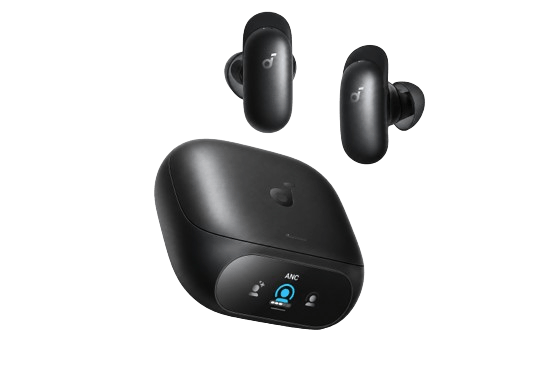
The soundcore Liberty 5 Pro sits in the $150 to $200 band with 8 microphones, 2 VPUs, and an AI Large Model. Jabra Elite 10 Gen 2 leans toward 6-mic call handling and all-day comfort. Apple AirPods Pro 3 makes more sense for buyers deep in the Apple ecosystem. Liberty 5 Pro is also Guinness World Records certified for the highest speech quality score (G-MOS) for TWS earbuds (objective test).
- Comfort determines whether strong numbers stay livable past the first hour. Weight, shell shape, and ear tip options all feed into fit. Even a 5-gram gap can register after a long session. Stock tips are not always the right match, so multiple sizes are worth trying. Unstable fit or ear pressure will not be fixed by better ANC or a fancier codec.
Treat these seven areas as a priority stack, not a scorecard where every line item needs to max out. Ready to line up models across all seven? A filtered true wireless earbuds collection sorted by price range is a straightforward way to cross-reference specs before you narrow down to a short list.
Three Marketing Traps You Should Avoid
Earbuds marketing leans hard on headline numbers. A single spec on the box often becomes the whole purchase decision, and that is where buyers overpay or pick the wrong pair. Three patterns show up constantly.
The percentage noise canceling claim.
“Up to 99% noise reduction” reads sharper than “up to 96%.” That extra digit rarely compares apples to apples. One brand may measure office hum; another may target airplane cabin noise. Percentages across manufacturers are hard to line up. dB attenuation from the same third-party lab setup tends to be the more useful figure.
Brand premium versus the gap you feel day to day.
A $150 Sony pair may bring stronger tuning polish, a more mature app, or more consistent ANC than a $100 soundcore model. The price gap is real on paper. Casual listening, commuting, and basic calls do not always reflect it at full scale. A well-equipped $100 pair such as Liberty 4 NC can land close enough to a mid-range Sony or JBL option for many users.
Over-specification on the spec sheet.
LDAC earns a line on feature lists for good reason. The codec only helps when the phone supports it, and the listening space is quiet enough to hear finer details. iPhone owners never use LDAC. Plenty of Android listeners on buses, treadmills, or video calls will not hear a clear upgrade either. Before paying extra for high-resolution codec support, check device compatibility, music source quality, and whether listening conditions leave room for the difference.
Also read: Best Wired Earbuds in 2025 for Every Budget and Lifestyle
How to Choose Earbuds by Use Case
Understanding how to choose wireless earbuds is easier when you start with a scenario and budget instead of brand rankings.
For commuters and city users ($150–$200)
Commuters should put strong ANC and long-wear comfort ahead of niche audio features. Subway rumble, bus noise, and crowded streets are exactly where steady noise control matters.
In this range, Soundcore Liberty 5 Pro ($169.99) offers Adaptive ANC 4.0, IP55 water resistance, multipoint connection, and 8 microphones with 2 VPUs. Sony LinkBuds S ($159.99) weighs about 4.8 grams per earbud and targets lighter, all-day wear with high-quality noise canceling. The right choice depends on whether your daily pain point is background noise, ear fatigue, or calls between stops.
For runners and gym users ($75–$150)
Workout buyers should care more about fit, water resistance, and simple controls than high-end codec support. Liberty 4 NC ($99.99) offers Adaptive ANC 2.0, IPX4 water resistance, and 6 microphones with an AI call algorithm.
JBL Tune 230NC ($99.95) offers JBL Pure Bass Sound, IPX4 water resistance, and app-based personalization through the JBL Headphones App. Jabra Elite 4 Active adds an IP57 rating and a secure active fit if durability matters more. If you train outdoors often, do not treat IPX4 like a fully waterproof rating.
For home office and frequent meetings ($150–$300)
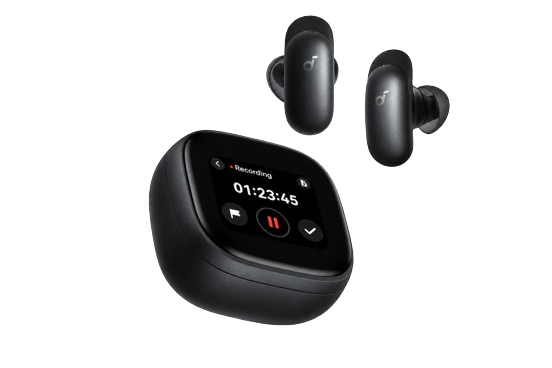
Home office users should start with multipoint, call clarity, and battery behavior. soundcore Liberty 5 Pro Max ($229.99) uses the same earbud platform as Liberty 5 Pro, with Adaptive ANC 4.0, multipoint connection, 8 microphones with 2 VPUs, and up to 6.5 hours of playback with ANC on (28 hours with the case).
It adds a 1.78-inch AMOLED smart case with AI Note-Taker. Basic recording through the case microphone is free; transcription and summaries require a subscription, with the included Starter Plan offering 120 minutes per month for 24 months. The case records only in-person, in-room audio and does not capture online meetings, video calls, or phone calls.
Apple AirPods Pro 3 ($249) suits buyers in the Apple ecosystem, Jabra Elite 10 Gen 2 ($279) suits buyers who prioritize comfort and 6-mic call handling, and Bose QuietComfort Ultra Earbuds (2nd Gen) ($299) are worth comparing if ANC depth matters more than meeting notes.
For first-time buyers on a tight budget ($50–$100)
Near $100, JBL Tune 230NC ($99.95) and soundcore Liberty 4 NC ($99.99) cover active noise canceling and stable Bluetooth. Liberty 4 NC runs up to 8 hours per charge with ANC on, and 40 hours total with the case. JLab Go Air Pop ($25) sits lower on price with IPX4 splash resistance and 32+ hours of playtime, but no ANC. Paying extra for features that do not map to anything in a typical week rarely turns out to be worth it.
Conclusion
A $100 pair and a $200 pair are closer than they used to be. The real gap is not the price — it is picking earbuds matched to how your week actually runs versus picking whatever topped a roundup. Where you listen most, what you can spend, and which specs show up daily are still the right starting points. ANC consistency, fit, call hardware, battery life with ANC on, and codec support tend to sort themselves out from there.
Percentage noise claims and brand reputation are worth questioning. dB attenuation, microphone count, IP rating, and real playback time with ANC running are harder to dress up and tend to tell you more.
Soundcore, Sony, Jabra, Apple, and JBL each cover different corners of the market, with distinct trade-offs at every tier. None of them makes the best pair for every listener. The best true wireless earbuds are the ones that fit how you commute, train, work, and take calls.
FAQs: True Wireless Earbuds
Are expensive true wireless earbuds worth it over $100 models?
Often, though not always. Moving from a solid $100 pair to a $150 or $200 model tends to show up in ANC consistency, call clarity, comfort during long sessions, and more predictable battery behavior. Above $200, the extra cost usually goes toward ecosystem features, spatial audio, or AI meeting tools — none of which matter if they do not fit a typical week.
Do noise canceling percentage claims mean anything when comparing earbuds?
Not much on their own. One brand may measure office hum; another may target airplane cabin noise. A higher percentage on the box does not guarantee stronger real-world quiet. When available, dB attenuation from a third-party lab setup is the more useful figure. For everyday shopping, comparing by use case and verified specs gives a clearer picture than headline percentages alone.
Does LDAC matter if you use an iPhone?
No. LDAC is an Android-side high-resolution codec. iPhone playback runs through AAC instead, so paying extra for LDAC support has no benefit on iOS. On Android, it only delivers a noticeable difference when the phone supports it and the listening environment is quiet enough to hear finer detail.






Leave a comment